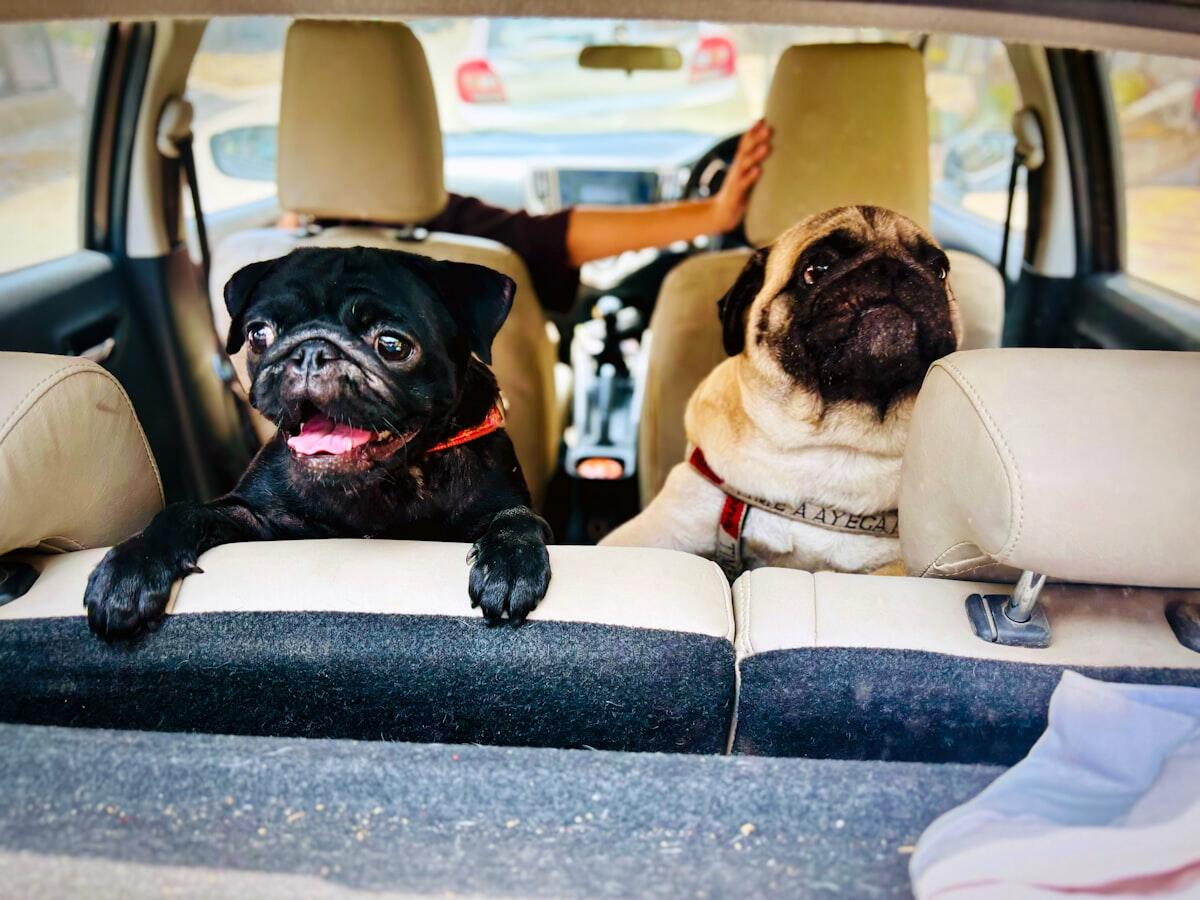
A practical NZ guide to travelling with your dog in the car — restraint options ranked by crash protection, NZ law on ute trays, car sickness, and summer heat.
Māui’s first car trip as a pup went about how you’d expect: a wet nose on my ear at 80km/h on the Porirua motorway, followed by a brief and illegal migration to my lap at the next set of lights. I’ve driven with a restrained dog ever since, and I’ve watched enough near-misses on SH1 to have opinions about how other people do it.
This is the practical guide. NZ law, what actually works for restraint, car sickness, the summer heat problem, and a checklist for longer trips. Products show up where they’re useful — not as a listicle.
The short version
- Restrain every trip, even short ones. Most crashes happen within 8km of home.
- Crash-tested seatbelt harness + back seat = the default answer for most dogs. See the best crash-tested dog car harness guide for specific picks.
- Never leave a dog in a parked car between November and March. Not even with the windows down.
- Stop every 2–3 hours on long drives for water, a toilet break, and a leg stretch.
- Ute tray: tether or cage, always. That one’s a legal requirement, not a suggestion.
Yes, there are affiliate links below. No, they don’t change what I recommend.
NZ law: what’s actually required
NZ’s restraint rules are narrower than most people think.
Ute trays are covered by the Animal Welfare (Care and Procedures) Regulations 2018. A dog on the back of a moving ute must be tethered short enough that it can’t fall off the tray or be thrown over the side, or it must be caged. Breach that and you’re looking at a $300 infringement fee — and in a sudden brake, an untethered dog on a ute is usually a dead dog. This part isn’t up for debate.
Inside the car there’s no specific law requiring restraint. No fine for an unrestrained Labrador riding shotgun. What you do get is two indirect risks: a careless driving charge if the loose dog distracts you, and whatever a 25kg dog turns into at 50km/h when you brake hard.
That number is worth sitting with. A 25kg dog in a 50km/h crash hits with roughly 750kg of force. A 40kg Lab hits with around 1,200kg. The dog is the projectile; so is everyone else in the car once the dog has finished travelling through them.
NZ’s law on this is behind Australia’s and Europe’s. Don’t wait for it to catch up.
Restraint options, ranked by crash protection
Any restraint is better than none. But they’re not equal.
1. Crash-tested crate or carrier in the boot
The gold standard. A rigid crate secured against the back seats gives the dog a structured space that’s been designed to survive impact forces. Brands like Gunner and Variocage are the serious picks — expensive, heavy, not for small hatchbacks. For most NZ owners this is overkill unless you’re driving with multiple dogs or competing in dog sports.
2. Crash-tested seatbelt harness on the back seat
This is the right answer for most people. A proper crash-tested harness — the Kurgo Enhanced Strength Tru-Fit, EzyDog Drive, or Sleepypod Clickit — distributes crash forces across the chest and keeps the dog on the seat. Crash-test standards vary (Sleepypod uses the US CPS standard; Kurgo is manufacturer-tested) — full breakdown in the best crash-tested dog car harness guide.
Thread the car’s seatbelt through the built-in loop, click, done. Back seat only — never the front, unless you’ve disabled the passenger airbag. If your harness doesn’t have a built-in seatbelt loop, pair it with a dedicated tether like the Kurgo Direct to Seat Belt Tether (~$29 NZD) instead of clipping to the collar.
3. Cargo barrier between boot and back seat
A barrier doesn’t restrain the dog; it contains them. For a Lab or German Shepherd in a station wagon or SUV, this is usually the practical answer. The dog can sit, stand, or lie down in the boot, and the barrier keeps them there. Pair with a seat cover or hammock and a non-slip mat.
4. Booster seat with tether (small dogs)
A booster elevates a small dog enough to see out the window — which cuts down on anxiety and motion sickness — and the tether stops them launching themselves forward. Not as crash-protective as a harness alone, but a fair trade for anxious small dogs. See the best dog car booster seat guide.
5. Walking harness clipped to the seatbelt
Better than nothing, worse than everything above. A walking harness isn’t built for crash forces — the stress points are wrong and the hardware can fail. If it’s what you’ve got for a one-off trip, use it. For regular driving, buy the right gear.
Car sickness: what actually helps
Most puppies grow out of car sickness by about 12 months. For the ones that don’t, there are a few things worth trying before resorting to medication.
Feed at least two hours before driving. An empty-ish stomach handles the motion better.
Raise the dog enough to see the horizon. This is where a booster seat earns its price for small dogs. For medium dogs, a rear hammock like the Kurgo Wander Hammock lifts them enough to see out the window — waterproofing section of the seat cover guide covers this in detail.
Crack a window. A small amount of airflow helps more than you’d think. Don’t let the dog stick their head out — the ear-flap damage from prolonged 80km/h wind is real, and a flying stone will ruin your day.
Short, positive trips. Five minutes to a park, then home. Build the association before the first long drive.
If it’s severe, ask your vet. Maropitant (Cerenia) is specifically licensed for canine motion sickness and is genuinely effective. Sedation is a last resort — a sedated dog is a dog that can’t brace for a crash.
Summer heat: the one that kills dogs
NZ’s summers are mild until suddenly they aren’t. On a 22°C day, a parked car reaches 40°C inside within 30 minutes. On a 28°C Auckland or Blenheim afternoon, it hits 50°C. Cracking a window doesn’t fix this.
Heatstroke in dogs sets in around 41°C core temperature. Brachycephalic breeds — French Bulldogs, Pugs, Boxers — go down faster because they can’t pant as effectively. The SPCA runs a public campaign on this every summer for a reason: dogs still die in parked cars in NZ every year.
Rules that actually work:
- Don’t leave the dog in the car between November and March, full stop. Not “just for a minute.” The minute turns into twenty.
- If you see a distressed dog in a parked car, call 105 or the SPCA. Under the Animal Welfare Act, police can break a window if the dog is in clear danger.
- Water in the car, always. A collapsible bowl and a bottle like the Kurgo Gourd Water Bottle & Bowl (~$28 NZD) lives permanently in the boot — the bowl unscrews from the base, you pour, dog drinks. Costs less than a café lunch.
- Sun shades on the windows if the car is parked in direct sun even while you’re driving. Back-seat dogs cook faster than front-seat humans.
- Watch for early heatstroke signs: heavy panting, bright red gums, drooling thicker than normal, wobbly gait. Get to shade and cool water immediately.
The NZ road trip checklist
For anything more than an hour’s drive — think Auckland to Taupō, Wellington to Napier, Christchurch to Queenstown — pack properly. You don’t want to be pulling into a Caltex at 9pm looking for a dog bowl.
Restraint and comfort
- Crash-tested harness or crate — fitted and tested before the trip, not in the driveway with a nervous dog
- Non-slip mat or seat cover — pick one with waterproofing if you’re anywhere near a beach
- Familiar blanket or bed — smell matters more than fabric quality
Hydration and food
- Water bottle with integrated bowl (the Kurgo Gourd does this; so does the Thirsty Dog Bottle if you want a Kiwi-owned option)
- Collapsible bowl as backup
- Regular food in a sealed container — don’t switch brands mid-trip
- A couple of treats for toilet stops, nothing fatty that’ll upset their stomach
Health and admin
- Current council registration tag on the collar
- Microchip details up to date (Dogs NZ or NZCAR) — do this before you leave
- Any regular medication in its original packaging
- Vet records saved in your phone — handy if you end up at an after-hours clinic in a town you don’t know
- First aid basics: tick remover, vet wrap, saline for flushing cuts
Stop schedule
Every 2–3 hours, no exceptions. Dogs cope with long drives better than humans do, but stiffness, bladder, and overheating all stack up. Use the stop for water, a short walk, and a check that the harness hasn’t rubbed raw anywhere.
On-lead everywhere you stop. NZ is full of unfamiliar dogs, stock fences, and highway traffic. Your dog doesn’t know the area. A sudden lead at the truck stop is cheaper than a lost dog on SH1.
What not to do
Don’t let the dog ride loose in the ute tray. It’s illegal, and even with a lead clipped to a centre point, a dog on a moving tray can still be thrown. Tether short to both sides, or use a cage.
Don’t clip a lead to the collar as a “restraint.” In a crash it’ll break the dog’s neck. Harness only.
Don’t trust a cheap universal seatbelt clip with no harness. Same problem — the clip attaches to the collar and becomes a noose.
Don’t bother with inflatable car beds that don’t have a tether point. Comfortable, but the dog slides off the first time you brake.
Don’t feed the dog a big meal in a motorway service station and then get back on the road. Two hours minimum between food and driving, or you’ll be scrubbing the back seat in Taihape.
Where to buy travel gear in NZ
- Animates — widest in-store range across Kurgo, EzyDog, Solvit. Staff will help with sizing.
- PetDirect — competitive online pricing, free shipping over $49
- Petstock — decent selection, carries Yours Droolly for budget options
- Kmart — basic booster seats, collapsible bowls, cheap first-trip gear
- Supercheap Auto — surprisingly good for dog seatbelt clips and cargo barriers
- EzyDog NZ — direct for the full EzyDog range
- Mighty Ape — accessories and booster seats
Kurgo products are stocked at Animates and PetDirect in-store, or through the affiliate link above for the full Kurgo range.
Bottom line
- For small dogs: a booster seat with tether, back seat, away from the airbag.
- For medium and large dogs: a crash-tested seatbelt harness, back seat, every trip.
- For very large dogs in wagons or SUVs: a cargo barrier plus a waterproof seat cover in the boot.
- For the ute tray: tether short or cage. Not optional.
- For summer: water in the car, and never the parked-car risk. Not even for a minute.
The gear doesn’t cost much compared to a vet bill, a windscreen, or the alternative. Restrain your dog, pack a bowl, stop every couple of hours. The rest is just driving.
Prices are approximate NZ retail as of April 2026 and vary by retailer and size. Last reviewed April 2026.
 PawPick