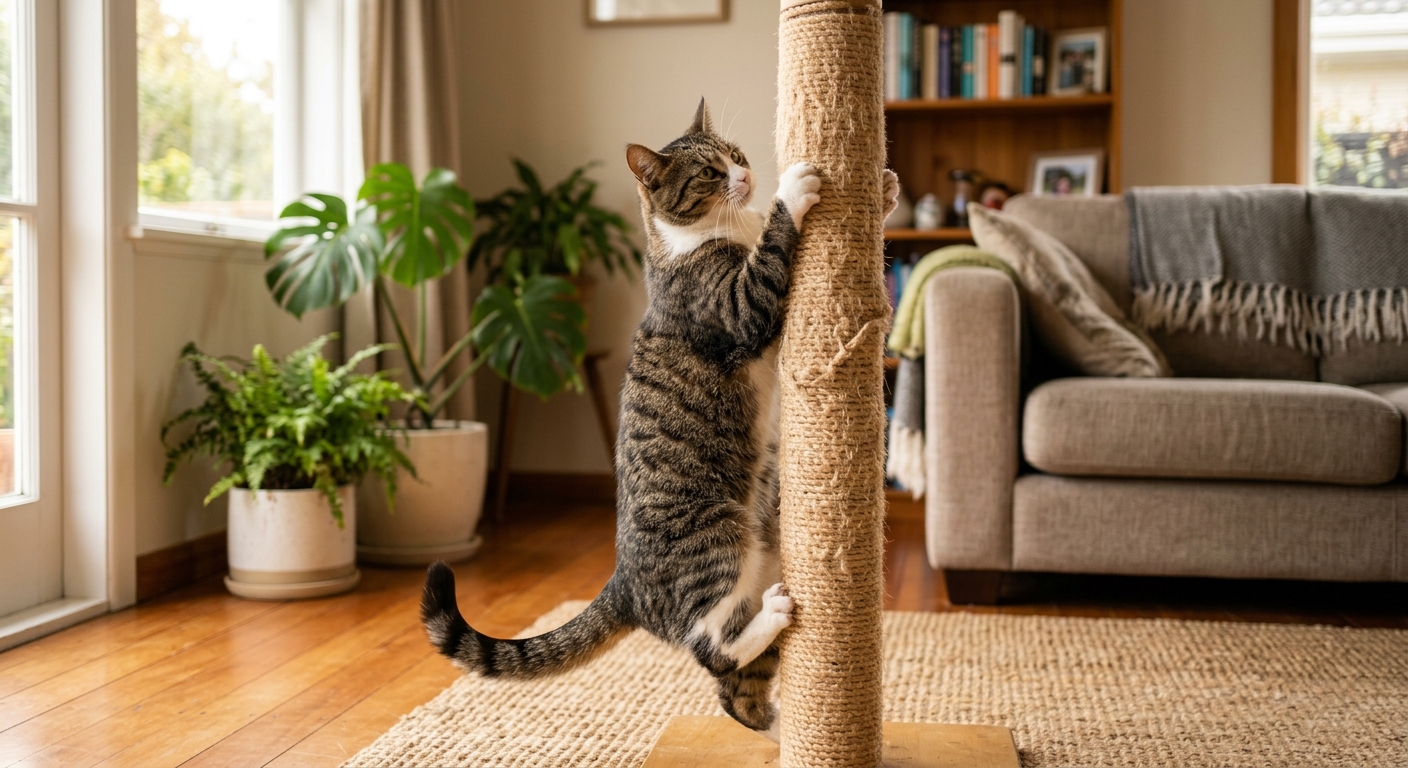
Best cat scratching posts NZ quick picks for 2026: tall sisal posts for most cats, giant posts for large breeds, towers for indoor cats, cardboard scratchers for rug-scratchers, and a sofa-retraining add-on.
The short version
For most NZ cats, the best cat scratching post is boring in exactly the right way: tall, stable, and wrapped in sisal. The KatAttack Sierra Cat Post is the buy-once pick: Auckland-made, heavy enough to feel like furniture, and available in an 80 cm version that lets most adult cats stretch properly. If you want a local-store option, the Kazoo Cat Scratch Post from Animates is a sensible mid-range fallback. Tight budget? The Kmart cat scratcher or a basic cardboard flat scratcher will do the job while you work out what your cat actually prefers.
The single biggest mistake NZ cat owners make: buying a post that’s too short, or hiding it in a room the cat does not care about. Both problems are cheaper to fix than a shredded sofa.
If you are building an indoor-cat setup, treat scratching as one part of the system: the right cat litter keeps the tray usable, a cat tree adds climbing space, and indoor cat food keeps calories realistic for a cat that is not roaming all day.
Quick comparison
Affiliate note: PawPick may earn from the PetSafe link above. I did not add Fur King or VetSupply CTAs here because the current visible ranges do not show a verified cat scratching-post match; forcing a grooming, bed, or parasite merchant into a scratcher guide would be worse for readers.
Why cats scratch — and why stopping them is the wrong goal
Cats scratch because it is normal cat behaviour: claw maintenance, stretching, emotional release, and marking territory. SPCA NZ’s 2026 home-cat guidance recommends offering both horizontal and vertical scratching options in different locations and making vertical posts taller than your cat when fully stretched.
None of this is optional behaviour. A cat that isn’t scratching on something appropriate is scratching on something inappropriate — your couch, door frames, or carpet.
The job of a scratching post isn’t to stop scratching. It’s to give your cat a better option than your furniture, and to put that option somewhere they’ll actually use it. Getting that right matters more than which specific product you buy.
A cat that’s well set up with scratching surfaces has a much fairer alternative to your couch and a useful outlet for normal territorial behaviour — particularly important for indoor cats who cannot patrol outside. If claws are overgrown, cracked, painful, or catching badly, talk to your vet or a professional groomer rather than treating a scratching post as medical care. Pair good scratching options with a quality diet and appropriate enrichment for the best outcomes.
Types of cat scratchers
Vertical sisal posts
The standard format — a post wrapped in sisal rope or fabric, mounted on a weighted base. Works for cats that scratch walls, door frames, furniture legs, and anything vertical. The post needs to be tall enough for a full stretch and stable enough not to rock when the cat pulls on it.
- Best for: Most cats, especially those already scratching vertical surfaces
- Watch out for: Posts under 65 cm, which are too short for most adult cats to fully extend; hollow bases that rock
Cat towers / multi-level trees
A post — often several — combined with platforms, hideaways, perches, and sometimes hammocks. Adds climbing and resting enrichment beyond just scratching. Relevant particularly for indoor cats who need more stimulation and vertical space.
- Best for: Indoor-only cats, multi-cat households, active breeds (Bengals, Abyssinians)
- Watch out for: Poor stability at height — a tall tower with a small base that tips is dangerous; and posts wrapped in carpet rather than sisal (carpet wears faster and is harder to replace)
Horizontal cardboard scratchers
Flat or angled corrugated cardboard pads. Some cats prefer horizontal scratching — they scratch the floor, rugs, and doormats rather than walls and furniture. A horizontal scratcher suits them directly.
- Best for: Cats that scratch carpets and rugs rather than vertical surfaces
- Watch out for: Cardboard produces dust as it shreds — keep away from cats with respiratory issues; needs replacing every 1–3 months
Angled / incline scratchers
Sits at roughly 30–45 degrees, bridging horizontal and vertical. Good for cats that scratch both orientations, and for cats transitioning from carpet to sisal.
- Best for: Cats with mixed scratching habits; households introducing a scratcher for the first time
- Watch out for: Less common in NZ stores — most available online through Mighty Ape or Petdirect
Top picks
🥇 Best overall: KatAttack Sierra Cat Post
- Type: Vertical sisal post
- Height: 60 cm and 80 cm variants
- Price: ~$120–170 NZD direct from ComfyPet at the 22 July 2026 check; Petstock store pricing may differ
- Where to buy: ComfyPet.co.nz
- Best for: Cat owners who want the post to last years, not months
Made in Auckland with a 40 x 40 cm base, height options of 55 cm or 80 cm, and dense sisal on the working surface. That combination — a proper base, a tall option, and a replaceable-feeling scratching surface — is what separates it from the wobbly imports that end up in garage sales.
The 80 cm version is the one I would buy for most adult cats. The 55 cm version is cheaper, but it loses the whole point if your cat has to hunch. Go shorter only for a kitten, a small adult, or an older cat that genuinely cannot stretch comfortably on a tall post.
The hanging plush toy adds some first-week interest, but the boring bits matter more: weight, height, and scratchable texture. ComfyPet lists an estimated build time of about a week, so this is not the panic buy if the couch is being shredded tonight.
If you want to buy once and not think about it again, this is the pick.
Check the KatAttack Sierra at ComfyPet →
🏆 Best for large breeds: KatAttack tall scratcher range
- Type: Vertical sisal post
- Height: 100 cm and 120 cm
- Price: Varies by size and configuration; check the current ComfyPet range
- Where to buy: ComfyPet.co.nz
- Best for: Maine Coons, Ragdolls, Bengals, and any cat that’s outgrown standard posts
Same NZ-made logic as the Sierra, scaled up for large cats. For a Maine Coon, Ragdoll, big Bengal, or long young moggy that attacks door frames, look for 100 cm or more. Most standard posts sold in NZ are not in that league.
If you have a Maine Coon or Ragdoll and they’ve abandoned every post you’ve bought, height is the first thing I would suspect. A cat that cannot fully stretch has a good reason to ignore the post.
ComfyPet can often adjust KatAttack builds, but treat that as a custom-order conversation, not an assumption. Ask before buying if your cat is unusually large or you need a particular footprint.
Browse KatAttack giant scratchers at ComfyPet →
🏪 Best local-store option: Kazoo Cat Scratch Post (Medium)
- Type: Vertical sisal post
- Height: 74 cm
- Price: ~$135 NZD at the 22 July 2026 Animates check; promotional pricing and store stock can differ
- Where to buy: Animates nationwide (in-store and online)
- Best for: Cat owners who want to buy same-day from a physical store
Australian brand with solid NZ distribution. The 74 cm height is enough for most adult cats, the base is 40 x 40 cm, and the hanging ball adds enough novelty to draw a cat in during the introduction phase.
The furniture-grade plush base is the detail that matters most — it’s why this post sits on your floor without looking like an eyesore. If your post needs to live in a lounge or bedroom where appearances count, the Kazoo holds up to that better than most.
No platforms or hideaways — this is a single sisal post, and it does that well. Animates’ product data and page labels can disagree about delivery or stock, so check your actual store before treating it as a same-day rescue mission.
Check the Kazoo Cat Scratch Post at Animates →
💰 Best value: Tigga Pole Cat Scratcher
- Type: Vertical sisal post
- Height: 74 cm
- Price: Check current Petdirect price
- Where to buy: Petdirect.co.nz (check live stock and freight)
- Best for: Budget-conscious buyers who don’t want to compromise on quality
This is the value pick only when Petdirect has it live well below the $100+ sisal posts. The height is right for most cats, and the format is simple enough: one vertical sisal surface, one base, no cat-tower theatre. Available colours, price, and shipping thresholds can change.
The limitation is that it is an online availability pick. If it is available when you are reading this, it is excellent value. No extras — no toy, no platforms — just the format most cats need at a price that does not hurt.
Check price at Petdirect →
🏠 Best cat tower: Pet Pals Huron Cat Scratcher Tower
- Type: Multi-level cat tower
- Height: 81 cm
- Footprint: 59 × 49 cm
- Price: Check current Petdirect price
- Where to buy: Petdirect.co.nz (check live stock and freight)
- Best for: Indoor cats, apartment dwellers, households wanting scratching and resting in one piece of furniture
Three levels, a tunnel-style middle hideaway with removable cushion, a top viewing perch, sisal-wrapped posts, and a hanging toy — all in a footprint that fits comfortably in a corner. For cats that need scratching, climbing, perching, and hiding (which describes most indoor-only cats), this covers the brief without needing a living-room-sized cat tree.
The three levels are the selling point. This is not the cheapest way to solve scratching, but it makes sense when the same piece of furniture also needs to provide a perch, a hide, and a place to nap.
Good for cats of any age from kitten to senior, as long as the platform sizes suit your cat and the tower fits your room. Check current Petdirect stock and freight before assuming the old price still applies.
Check price at Petdirect →
📦 Best cardboard scratcher: Trixie Mimi Cardboard Scratcher Wave
- Type: Horizontal corrugated cardboard scratcher
- Price: ~$40 NZD at Animates at the 22 July 2026 check
- Where to buy: Animates (in-store and online)
- Best for: Cats that scratch rugs and carpets rather than walls; kittens; as a supplement to a vertical post
If your cat ignores vertical posts entirely but shreds your rugs, they’re a horizontal scratcher and a vertical post will always disappoint them. This is the right product for that cat.
The wave profile means some cats use it at a slight angle, which suits cats who scratch both orientations. The corrugated cardboard gives a satisfying shred for cats that ignore rope.
Needs replacing as the cardboard breaks down, so do not compare it to a sisal post on lifespan. It works best as a low-cost supplement: one vertical sisal post in the lounge, one flat cardboard scratcher in the bedroom.
Check price at Animates →
Getting placement right
A scratching post in the wrong spot will be ignored, regardless of quality. Cats scratch where they already spend time — they’re not going to walk to a back room they never visit.
Where to put it:
- Next to or near the furniture they’re already scratching — this is the highest-priority placement
- Beside their favourite sleeping spot — cats often scratch when they wake up, so a post near their bed makes natural sense
- In the main living area where the household spends most time — territory marking is more meaningful in busy spaces
Where not to put it:
- Spare rooms or laundry areas they rarely visit
- Directly beside the litter tray or food bowls
- Anywhere it blocks foot traffic — cats won’t use something they have to squeeze past to reach
If you’re transitioning a cat away from scratching furniture: put the post immediately adjacent to the piece of furniture they’re targeting. Once the cat is using the post consistently, move it a few centimetres at a time toward where you’d prefer it to live. Moving it all at once usually means the cat returns to the furniture.
What to look for when buying
Height
The post should be tall enough for your cat to fully extend — front legs above their head, back legs planted. For most adult cats, that’s 70 cm or more. Many posts sold for $40–60 are only 50–55 cm, which forces cats to hunch and defeats the purpose.
Check your cat’s length — nose to tail base — when they’re stretched out. The post should match or exceed that.
Stability
If the post rocks or tips when a cat pulls on it, they’ll stop using it. Heavy, wide bases on solid wood are the most stable. Hollow MDF bases wobble over time. Before buying, look at the base-to-height ratio — a narrow base on a tall post is a problem waiting to happen.
The test: push on the post with moderate force from the side. If it rocks noticeably, so will your cat’s experience of using it.
Sisal quality
Maritime-grade hand-wound sisal lasts the longest and stays tightly wound as the cat uses it. Machine-applied sisal can unravel at the edges and develops bare patches faster. If the wrapping looks loose or thin at the ends when you buy it, it’ll look worse within weeks.
Washability and repairability
Sisal can be re-wrapped when it wears out — if the base and structure are solid, this extends the life of the post significantly. Sisal rope is available from hardware stores for $15–30, and re-wrapping a post is straightforward. This makes a solid wood post a better long-term investment than a cheap hollow one, even if the purchase price is higher.
NZ-specific notes
NZ-made options are available: KatAttack is made in Auckland, and ComfyPet lists handmade-to-order build timing on the Sierra product page. For a category full of flat-packed imports, a domestic option with a visible workshop behind it is worth knowing about.
Damp homes and materials: If your flat gets humid or condensation-prone, avoid any scratcher you cannot dry, clean, or inspect properly. Sisal, solid wood, and cardboard are easier to judge at a glance than novelty materials with hidden cores.
Large breeds need more post: Standard 50–60 cm posts are genuinely too short for many Maine Coons, Ragdolls, Norwegian Forest Cats, and long athletic moggies. If you have a large cat, go straight to an 80 cm or 100 cm+ option.
Indoor cats need more: NZ cat owners are increasingly keeping cats indoors, particularly in urban areas and for wildlife protection. Indoor cats without outdoor scratching options need more scratching surfaces — minimum one per cat, spread across the home, with at least one tall enough for a full stretch. For indoor cats, adding a tower with climbing and perching enrichment makes a genuine difference to their quality of life — our guide to the best cat tree in NZ covers the full range of options if you want to go beyond a standalone post.
Where to buy in NZ:
- Animates (nationwide stores + online): Best for same-day in-store purchase; stocks Kazoo, Trixie
- Petdirect (online): Check current Tigga, Pet Pals, Pup & Purr stock and freight before comparing
- ComfyPet (online): Best source for the NZ-made KatAttack range
- Mighty Ape (online): Good range of mid-range cat towers and trees, Zoomies brand
- Kmart / The Warehouse: Budget options from ~$25–40 for cardboard and basic posts
Quick reference
| Budget | Best pick | Where to buy |
|---|
| ~$40 | Trixie cardboard scratcher | Animates |
| ~$120–170 | KatAttack Sierra (Auckland-made, 55 cm or 80 cm) | ComfyPet.co.nz |
| ~$135 | Kazoo Cat Scratch Post (check local stock) | Animates |
| Check current price | KatAttack tall scratcher range | ComfyPet.co.nz |
| Check current price | Pet Pals Huron Tower | Petdirect.co.nz |
Related guides:
 PawPick