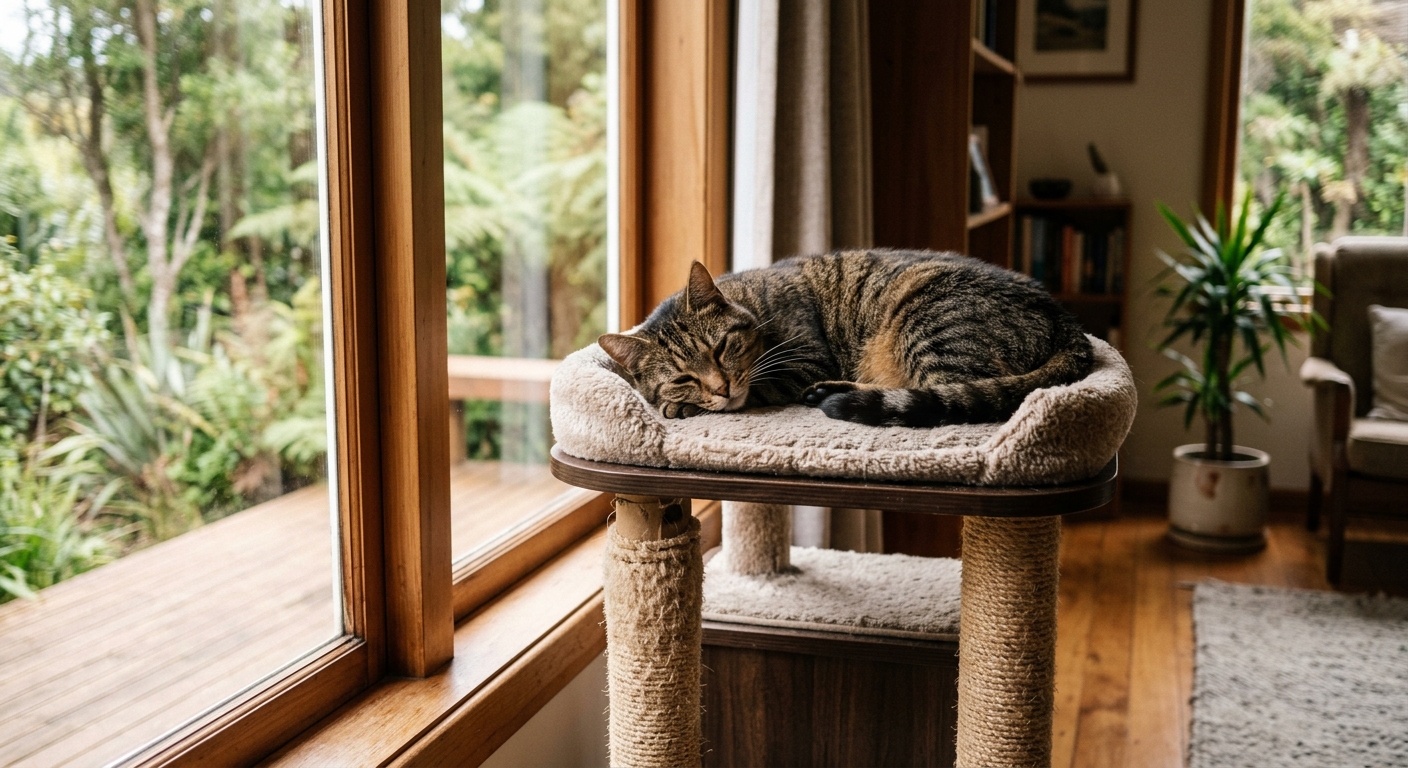
The best cat trees available in New Zealand — from compact apartment towers to heavy-duty trees for Maine Coons. Real NZ prices, where to buy, and what cats actually use.
The short version
For most NZ cat owners: the FEANDREA Large Cat Tree — widely available on Trade Me and Mighty Ape for $149–199, solid construction, multiple platforms, and genuinely used by cats rather than ignored. If you want something built to last a decade and available in-store today, the Vesper V-High Tower from Animates is the premium choice. Tight budget? The Paws & Claws Basic from Animates will do the job while you work out what your cat actually wants.
The two biggest mistakes NZ cat owners make: buying a tree with platforms too small for the cat to lie on, or putting it in a room the cat never visits. Both problems solved below.
Why indoor cats need a cat tree
An outdoor cat gets to climb fences and trees, scratch on wood and bark, and survey their territory from height. An indoor cat can’t do any of that — unless you give them somewhere to do it inside.
Cat trees address three needs simultaneously: scratching (removing dead claw sheaths and marking territory), climbing and perching (cats feel safer when they can observe a room from above), and resting (a defined sleeping spot that’s theirs alone). A cat without these outlets will scratch your furniture, jump onto kitchen benches, and generally make itself unpopular.
For NZ cats — where indoor-only keeping is increasingly common, particularly in urban areas and for wildlife protection reasons — a cat tree isn’t a luxury. It’s functional enrichment. Pair it with a quality indoor diet, the right scratching posts, and a low-mess cat litter setup and you’ve covered most of what an indoor cat needs.
What separates a good cat tree from a bad one
Cat trees vary enormously in quality. The cheap ones wobble, tip, or fall apart within months. The expensive ones don’t always justify the price gap. Here’s what actually matters:
Stability
This is the most important factor. Cats launch off trees at full speed. A wobbly tree erodes their confidence and gets abandoned; a collapsing one is dangerous. Key stability markers: base at least 50 cm x 50 cm for a medium tree, poles 9 cm+ in diameter, and solid bolt construction rather than push-fit plastic.
Small platforms look good in photos but a cat won’t sleep on them. Any sleeping platform should be at least 30 cm x 30 cm — ideally 35 cm x 35 cm or more for average-sized cats. Large breeds need 40 cm+. Check this before buying; product photos routinely flatter.
Scratching material
Most cat trees use sisal rope or carpet. Sisal is better — cats prefer the texture, it’s more durable, and it doesn’t attract lint. Carpet scratching posts pill quickly and can encourage cats to scratch your actual carpet. A tree with sisal-wrapped posts on every vertical section gives your cat the best scratching surface.
Build quality
Thin cardboard tubes compress over time. Particle board platforms chip and swell with moisture — relevant in NZ’s humid regions. Plastic connecting hardware strips during assembly. Better trees use thick-walled posts, MDF or plywood platforms, and steel threaded inserts for bolt connections. You can check this by looking at the assembly instructions: if the tree uses plastic clips rather than bolts, it’s low quality.
Top picks
🥇 Best overall: FEANDREA Large Cat Tree
- Height: ~150 cm
- Base: ~52 cm x 52 cm
- Platform size: 25–35 cm (varies by level)
- Weight capacity: ~10 kg per platform
- Price: $149–199 NZD
- Where to buy: Trade Me (multiple NZ sellers), Mighty Ape
- Best for: Most cats, multi-cat households, active adults
The FEANDREA line (manufactured by SONGMICS) has become the most popular mid-range cat tree in New Zealand and Australia — and for good reason. The large model packs in 4–5 levels with varied platform heights, one or two enclosed condos, sisal-wrapped posts on every vertical section, and a hanging toy, at a price point that undercuts comparable quality from pet specialty stores.
Assembly takes about 45 minutes and rewards care — tighten every bolt properly and this tree is genuinely stable. Rushed assembly is what causes the wobble complaints you’ll occasionally see in reviews. The plush surface attracts hair, but a rubber lint roller handles it.
For a multi-cat household or an active single cat, this delivers the best combination of features, stability, and value available in NZ right now.
Check price at Mighty Ape →
🏆 Best premium: Vesper V-High Tower
- Height: ~162 cm
- Base: ~52 cm x 52 cm
- Platform size: 35 cm+ on upper levels
- Weight capacity: 10 kg per platform
- Price: $299–349 NZD
- Where to buy: Animates, Pet Direct
- Best for: Cat owners who want quality that lasts, or a tree that suits modern NZ interiors
Vesper (made by Catit) makes cat furniture that holds up to years of daily use. The V-High Tower uses higher-density board, quality felt-style fabric covering, and proper steel hardware. Crucially, Catit sells replacement sisal and fabric panels — so when parts wear out, you replace them rather than replacing the whole tree.
The aesthetic matters too. Most cat trees look like they belong in a pet store display. The Vesper is designed to fit a modern New Zealand living room — available in white/grey colourways, clean lines, a built-in storage compartment in the base. If the tree is going in a visible spot, this distinction is real.
What you’re paying for over the FEANDREA: longevity (genuinely lasts years longer), repairability, and aesthetics. If you’re setting up a permanent indoor cat environment rather than testing whether a cat tree helps, this is the right long-term investment.
Check price at Pet Direct →
🏠 Best for apartments: Catit Cat Tower with Condo
- Height: ~100–120 cm
- Base: ~45 cm x 45 cm
- Weight capacity: 8 kg per platform
- Price: $99–149 NZD
- Where to buy: Animates, Pet Direct, PetStock
- Best for: Apartments, smaller homes, cats up to 6 kg
Not every NZ home has space for a 150 cm wide-footprint tower. The Catit Tower is designed for apartments — narrow base, vertical height rather than lateral spread, enclosed condo, sisal posts, and an integrated ball toy, all in a footprint that fits comfortably in a corner.
The trade-off is platform size — upper platforms are around 28 cm x 28 cm, which suits most cats but not large breeds. For average-sized cats in a Wellington apartment or Auckland flat where floor space is genuinely scarce, this is a well-made buy that doesn’t dominate the room.
Check price at Pet Direct →
💪 Best for large cats: FEANDREA XXL Heavy-Duty Cat Tree
- Height: ~170 cm
- Base: ~60 cm x 60 cm
- Platform size: up to 42 cm x 40 cm
- Weight capacity: 15 kg+ per platform
- Price: $199–249 NZD
- Where to buy: Trade Me, Mighty Ape
- Best for: Maine Coons, Ragdolls, Norwegian Forest Cats, and any cat over 6–7 kg
Standard cat trees fail large cats in two ways: platforms too small to lie on comfortably, and posts that sway under their weight. The FEANDREA XXL addresses both — extra-large platforms, thicker 11 cm base poles, and a 60 cm x 60 cm base that doesn’t shift when a big cat launches off the top.
Maine Coons and Ragdolls are popular breeds in New Zealand, and owners of these cats consistently report that standard trees get abandoned fast. If your large cat has ignored every tree you’ve bought, platform size and post stability are almost certainly the issue. This tree solves it.
Assembly is more complex than the standard FEANDREA — allow 60–90 minutes and tighten every screw twice.
Check price at Mighty Ape →
💰 Budget pick: Paws & Claws Basic Cat Tree (Animates)
- Height: ~70–90 cm
- Base: ~38 cm x 38 cm
- Weight capacity: 6 kg per platform
- Price: $69–89 NZD
- Where to buy: Animates stores nationwide
- Best for: Kittens, small cats, budget-conscious buyers, rental setups
Animates’ own-brand Paws & Claws range includes basic cat trees at accessible price points. Two to three levels, a sisal scratching post, and a plush-covered platform. The fabric frays faster, the single sisal post wears down quickly, and it’s not suitable for cats over 5 kg — but for a new kitten’s first tree, or a temporary setup in a rental, it does the job.
Widely available in Animates stores across NZ, so you can take it home the same day.
Check price at Animates →
Choosing the right tree for your home
Number of cats
One cat: Any of the above works. Match size to your cat’s age and activity level.
Two cats: You need enough platforms that both cats can be on the tree simultaneously without conflict. The FEANDREA Large (4–5 levels) works well. If your cats don’t get along, consider two smaller trees placed in different areas.
Three or more: Invest in a large, multi-level tree and supplement with wall-mounted shelves to create more vertical territory. Cats need to be able to get away from each other when they need to.
Your cat’s age
Kittens (under 1 year): Active and fearless — they’ll launch off the top with no warning. Prioritise stability. The FEANDREA Large is ideal. Avoid anything with a narrow base.
Adult cats (1–8 years): Match the tree to their personality. Active cats benefit from height; lazier cats just need a comfortable perch and scratching post within reach of their usual spot.
Senior cats (9+ years): Lower trees or models with shallower gaps between platforms are easier for cats with arthritis or joint issues. Avoid trees where the main sleeping platform requires a large jump. Pair with a senior-appropriate diet if your cat is slowing down.
Home type
Apartment (under 80 sqm): Choose a narrow-footprint tree — the Catit Tower or a compact FEANDREA model. A wide-base tree in a small room dominates the space and often ends up moved to where the cat doesn’t spend time.
House with multiple rooms: Larger trees work well. Place it near a window with a bird or garden view — cats use trees far more actively when there’s something to watch.
Rental property: A mid-range tree is genuinely worthwhile. Cat trees significantly reduce furniture scratching damage, which has real financial consequences in a rental that an owned home doesn’t face in the same way.
NZ-specific notes
Large breeds are common in NZ: Maine Coons, Ragdolls, and Norwegian Forest Cats are popular New Zealand pets. Standard 80–100 cm trees with 28–30 cm platforms are genuinely inadequate for these cats. If you have a large breed, go straight to the FEANDREA XXL or Vesper — the platform and post dimensions are sized correctly.
Indoor-only cats are increasingly common: NZ cat owners are increasingly keeping cats fully indoors, particularly in urban areas and in response to DOC and local council guidance around cat management. For indoor cats, a cat tree isn’t optional enrichment — it’s a functional substitute for the vertical territory and scratching surfaces they’d access outside. Minimum one tree per cat, placed where the cat actually spends time.
Humidity and materials: In Auckland, Northland, and the West Coast, high humidity can cause cheap particleboard to swell and fabric to mildew. Mid-range and premium trees use MDF or plywood and breathable fabric covers that handle NZ humidity better than budget alternatives.
Apartment living: New Zealand cities — particularly Auckland and Wellington — have a growing proportion of urban cat owners in apartments. Compact trees (Catit Tower, narrow-base FEANDREA models) make sense here. A tree that fits in a 2 m x 2 m corner is genuinely useful; one that requires moving furniture around to accommodate it often ends up in a room the cat doesn’t like.
Where to buy in NZ:
- Animates (nationwide + online): Best for in-store same-day purchase; stocks Vesper and Paws & Claws
- Pet Direct (petdirect.co.nz): Reliable shipping, good Catit and Vesper range; check for regular sales
- Mighty Ape (mightyape.co.nz): Competitive pricing on FEANDREA/SONGMICS, reliable NZ shipping
- Trade Me: Best source for FEANDREA products via NZ-based sellers — confirm seller ships from NZ if you need it quickly
- PetStock: Similar range to Animates; worth checking for promotional pricing on accessories
- The Warehouse: Small budget selection — functional if price is the primary consideration
Setting up and placing your cat tree
Location
Place the tree near a window if possible. East or north-facing windows work well in New Zealand homes — direct afternoon sun on a west-facing window can make upper platforms uncomfortably hot in summer.
Avoid isolated rooms. Cats are social animals and want to be where their household is. A tree in the corner of your living room will be used far more than one in a spare bedroom or laundry.
If you’re transitioning a cat away from scratching a specific piece of furniture: place the tree immediately adjacent to the furniture they’re targeting. Once they’re using the tree consistently, move it a few centimetres at a time toward where you’d prefer it to live. Moving it all at once usually means the cat returns to the furniture.
Getting a reluctant cat to use it
Some cats climb a new tree within minutes. Others ignore it for weeks. If yours isn’t interested:
- Sprinkle dried catnip on the platforms
- Hang a favourite toy from the top perch
- Rub their scent onto the tree using a blanket or towel from their sleeping spot
- Feed treats on the lower platforms to build a positive association
- Move the tree to where they already spend time — a tree in the wrong spot will always be ignored
Don’t force them onto it. Give it two to three weeks.
Maintenance
Weekly: Vacuum or lint-roll plush surfaces. Check bolts are still tight — especially in the first month.
Monthly: Inspect sisal posts for wear. Re-tighten all bolts.
Every 6–12 months: Replace sisal rope on worn posts if needed. Sisal rope ($5–10 per roll on Trade Me) wraps easily around most standard posts with a glue gun. This significantly extends the life of any tree with a solid core.
When the tree is past its useful life — platforms sagging, wobbling despite re-tightening — replace it. A wobbly tree that a cat doesn’t trust is worse than no tree.
Quick reference
| Budget | Best pick | Where to buy |
|---|
| Under $90 | Paws & Claws Basic | Animates |
| $100–150 | Catit Cat Tower (apartments) | Animates, Pet Direct |
| $150–200 | FEANDREA Large (most cats) | Trade Me, Mighty Ape |
| $200–250 | FEANDREA XXL (large breeds) | Trade Me, Mighty Ape |
| $300–350 | Vesper V-High Tower (premium) | Animates, Pet Direct |
Prices checked April 2026 and are indicative — retailer pricing changes frequently. Always verify current availability and pricing before purchasing.
 PawPick