Independent guide to the best cat carriers available in NZ — soft-sided, hard plastic, backpack, and airline-approved options. Honest picks, NZ pricing, and what to actually look for.
The short version
A top-loading soft-sided carrier handles most everyday needs — vet trips, short drives, moving house. They’re lighter, easier to store flat, and less stressful for cats than hard plastic because the flexible walls give slightly on tight corners.
For vet trips specifically: look for a top-loading option. Loading a reluctant cat through a front door is a two-person job. Loading from the top is one hand.
If you fly with your cat within NZ, you need a soft carrier that fits under the seat. If your cat travels as cargo internationally, you need an IATA-approved hard crate. Everything else is a soft bag.
Why carrier choice matters more than most owners realise
Most cats are carried so rarely that owners buy the cheapest option available, which turns every vet trip into a wrestling match. The result is a cat who associates the carrier with being chased around the house and forcibly stuffed into a box — and owners who avoid vet appointments because it’s so stressful.
A good carrier, used properly, changes this. Cats can and do learn to treat carriers as neutral or positive spaces. It takes a few weeks of the carrier being left out, not the annual ambush.
The carrier choice matters in two ways: ease of loading (top access makes this significantly easier), and stress during transit (smaller mesh panels and covered sides reduce visual stimulation and make cats calmer in the car).
Types of cat carriers
Soft-sided carriers
Fabric or nylon construction with mesh panels on multiple sides. The most common type for everyday use.
- Pros: Light, compressible for storage, flexible walls reduce bumping against hard surfaces, warmer in winter
- Cons: Not airline cargo-approved, can be damaged by a determined cat
- Best for: Vet trips, car travel, short-stay boarding, cabin travel within NZ
Hard plastic carriers
Rigid ABS or polypropylene shell with a wire or grille door. The traditional vet-trip carrier.
- Pros: Durable, easy to clean (important for car-sick cats), some are IATA-approved for cargo travel
- Cons: Heavier, bulky to store, no give on corners, louder when cat moves around
- Best for: Cargo air travel, cats who chew or scratch at soft carriers, regular long drives
Backpack carriers
Structured backpack with a bubble window or mesh front panel. Designed for hands-free carrying.
- Pros: Hands-free, stable on long walks, popular for cats who want to see out
- Cons: Heavier than soft bags, not suitable for long drives, most aren’t airline-approved
- Best for: Outdoor adventures with cat-harness-trained cats, short walks to the vet, urban cat owners without a car
Rolling/wheeled carriers
Soft or hard carrier with retractable handle and wheels, like a small suitcase.
- Pros: Easy to transport without carrying weight, good for large cats, airports
- Cons: Heavy, not suitable for rough terrain, impractical for short trips
- Best for: Frequent flyers, large cats, travel that involves airports or long flat corridors
Top picks
🥇 Best overall: Petsfit Comfortable Journey Soft Carrier
- Type: Soft-sided, top and front loading
- Price: ~$55–75 NZ
- Available at: PetDirect, Amazon NZ
- Best for: Most cats doing vet trips and short car travel
The Petsfit ticks the boxes that matter most: top-loading access (the single biggest quality-of-life feature for loading reluctant cats), mesh panels on three sides for ventilation, and a removable fleece mat that can be washed when the inevitable happens.
The internal volume is proportioned well for cats — not so wide that they slide around corners, deep enough for a stretched-out sleeping position. The shoulder strap is padded. The zips are chunky enough to operate one-handed.
Where it earns its top pick: the top loading. Once you’ve used a top-loader you won’t go back. Your cat goes in vertically, settles down, done. Closing a front-loading door on a cat who’s decided they’re not going takes coordination most of us don’t have at 8am before a vet appointment.
Fits under the seat on most NZ domestic flights (confirm dimensions against your airline’s current requirements before flying).
🥈 Best hard carrier: Petmate Two Door Top Load Carrier
- Type: Hard plastic, top and front loading
- Price: ~$60–90 NZ
- Available at: Animates, PetDirect, PetStock
- Best for: Cats who chew or scratch soft carriers; regular car travel; car-sick cats
The Petmate Two Door is the standard hard carrier available through NZ pet chains. Its advantage is the dual-door configuration: front door for loading, top door for when front loading isn’t working. The hard shell makes cleaning straightforward — wipe down with pet-safe disinfectant, no fabric to absorb odours.
Hard carriers hold up better than soft for cats who stress-scratch or chew mesh panels. If your cat has destroyed a soft carrier, or if they get carsick regularly, hard plastic is more practical. The plastic is thick enough to muffle road noise slightly, which some cats find calming.
Not airline cargo-approved without checking specific models against IATA standards. If you need certified cargo travel, look at the Petmate Sky Kennel range specifically.
🥉 Best backpack: Lollimeow Pet Backpack Carrier
- Type: Structured backpack with bubble window
- Price: ~$70–100 NZ
- Available at: Amazon NZ, specialty pet stores
- Best for: Outdoor-access cats, harness-trained cats, urban owners without a car
The bubble-window backpack is a specific product category: cats who are comfortable in a carrier and like watching the world go past do well in these. The front-facing bubble window gives a panoramic view while the mesh top provides ventilation.
Weight limit is typically 6–8kg, which covers most adult cats. The shoulder straps are padded and the back panel has a stiffener that keeps the carrier’s shape even when the cat shifts weight.
Not recommended for cats who are carrier-averse or stressed by visual movement — the whole point of the bubble window (watching things go past) is exactly what stressed cats don’t want. For anxious cats, a covered soft carrier is significantly better.
A practical choice for NZ owners who walk to their local vet or want to take their cat on outdoor enrichment trips.
Best airline cabin carrier: Sherpa Original Deluxe Pet Carrier
- Type: Soft-sided, front loading
- Price: ~$85–110 NZ (import)
- Available at: Amazon NZ, specialty stores
- Best for: Air New Zealand cabin travel, frequent flyers
The Sherpa is specifically designed to airline seat-under specifications and has a mesh front panel with a spring-steel structure that collapses under load (allowing the bag to compress when pushed under the seat) then springs back to shape. This is the feature that makes it genuinely airline-compatible rather than just technically fitting.
If you fly with your cat in-cabin regularly, this is the carrier to buy. For occasional travel, a standard soft carrier that meets your airline’s dimensions will work.
Always verify current airline requirements before travel — dimensions and policies change.
Best budget: Animates Basic Cat Carrier
- Type: Hard plastic, front loading
- Price: ~$30–45 NZ
- Available at: Animates stores nationwide
- Best for: Occasional vet trips, owned cats who are carrier-neutral
The standard Animates hard plastic carrier is adequate for cats who don’t need regular transport. Single front door, wire grille, plastic tray. No frills, easy to find, inexpensive enough that losing it to a cross-country move or a cat who’s destroyed it isn’t a disaster.
If your cat visits the vet once a year and loads without drama, this is all you need. If your cat fights the carrier, the absence of a top-load option makes this harder than it needs to be.
Sizing guide
| Cat weight | Carrier size | Notes |
|---|
| Under 3kg (kittens, small cats) | Small — ~40 x 23 x 27cm | Most budget carriers |
| 3–5kg (average adult cat) | Medium — ~48 x 28 x 30cm | Fits most cats |
| 5–7kg (large adult) | Large — ~55 x 33 x 35cm | Maine Coons, Ragdolls |
| 7kg+ | XL or hard crate | Check weight limits on soft carriers |
Measure, don’t guess. Length from nose to base of tail + 10cm = minimum carrier length. Height sitting + 5cm = minimum carrier height. When between sizes, go larger.
What to look for
Top-loading access. The most important feature for owners with cats who don’t load cooperatively. If your carrier only has a front door, your cat will make you earn it every time.
Ventilation on multiple sides. Mesh on at least two sides is the minimum. Good carriers have mesh on three sides. Single-mesh-panel carriers get stuffy on warm days.
Washable interior. A removable liner or wipeable hard floor is essential. Cats vomit, urinate, and shed significantly during stressful transport.
Secure latches. Test the door latch before you need it. A carrier that opens under force in a car is not a carrier — it’s a liability. Check that both front and top doors (where applicable) have secure mechanisms, not just tension clips.
Size for your cat, not your shelf. The temptation is to buy small to fit under a desk or on a shelf. A carrier your cat can’t stretch out in will cause problems.
Reducing carrier stress: what actually works
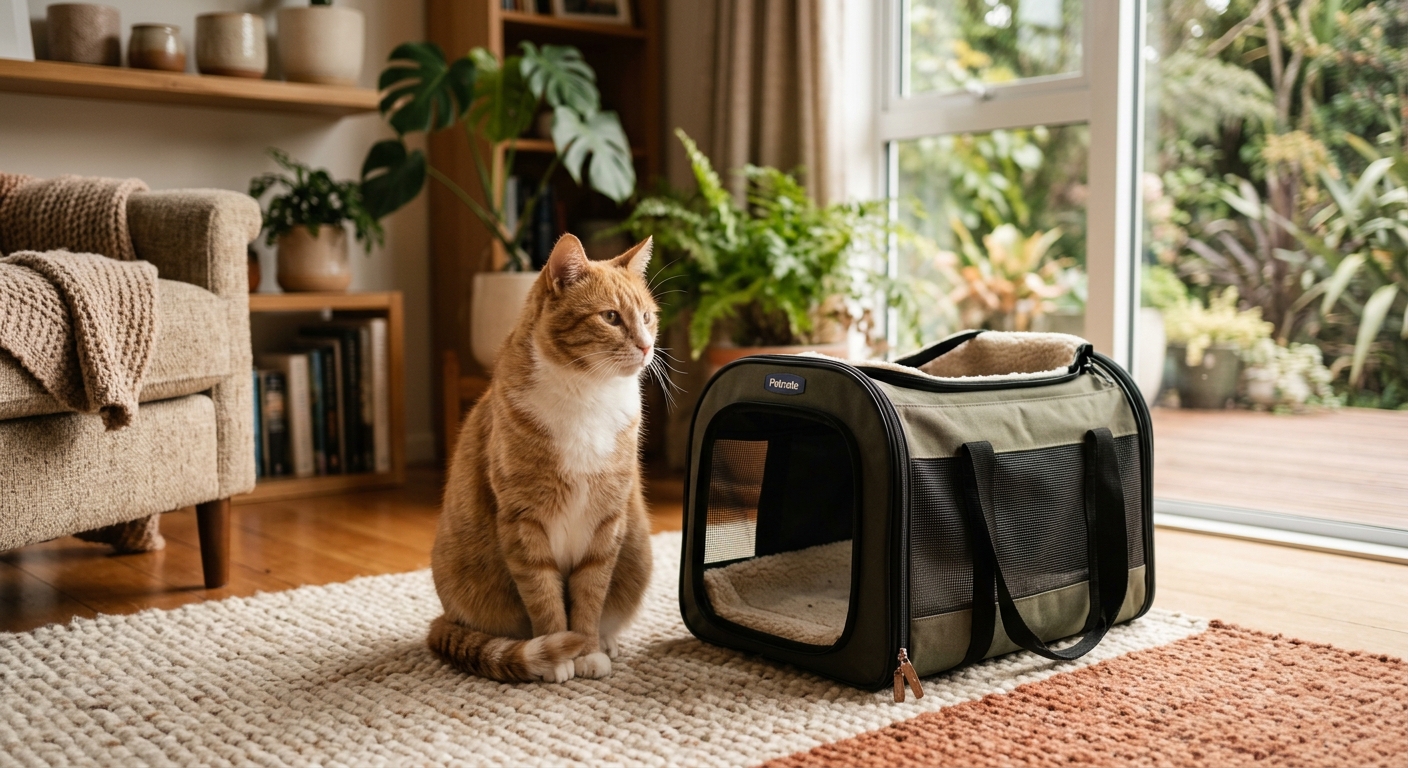
Leave the carrier out permanently. This is the most effective single intervention. Cats who live with a carrier in the room treat it as furniture. Cats who only see it on vet day know something bad is coming when it appears. Takes two to three weeks of the carrier being a neutral fixture before most cats stop reacting to it.
Feed near or inside the carrier. Put treats or a small portion of their meal in the carrier with the door open. Cats associate food strongly with safety — a carrier that has food memories is a different object from one that only has vet memories.
Use Feliway spray. Synthetic feline facial pheromones, available from most NZ vet clinics and PetDirect. Spray the interior 30 minutes before travel — it needs time to dry before your cat goes in. Don’t spray directly on the cat.
Cover it during transit. A light cloth over the carrier during car travel reduces visual stress significantly. Movement outside the carrier is alarming. A covered carrier is dark and enclosed, which most cats find calming.
Don’t reach in to get them out at the vet. Open the carrier fully and let the vet examine your cat inside it where possible. Many cats are calmer on a familiar surface than on an examination table.
NZ prices and where to buy
| Carrier | Type | Price (NZ) |
|---|
| Petsfit Comfortable Journey | Soft, top + front load | $55–75 |
| Petmate Two Door Top Load | Hard plastic, top + front load | $60–90 |
| Lollimeow Pet Backpack | Backpack, bubble window | $70–100 |
| Sherpa Original Deluxe | Soft, airline-compatible | $85–110 |
| Animates Basic Carrier | Hard plastic, front load | $30–45 |
NZ pricing, April 2026. Import pricing varies with exchange rate.
Where to buy in NZ:
- Animates / PetStock — basic hard plastic carriers reliably in stock; some soft options
- PetDirect — widest online range including Petsfit and Petmate
- Amazon NZ — backpack carriers and soft-sided options with reasonable delivery
- Vet clinics — some stock hard carriers; useful if you need one urgently
Last reviewed April 2026. A cat that loads into a carrier without drama makes everything easier — it’s worth the few weeks of desensitisation work.
 PawPick