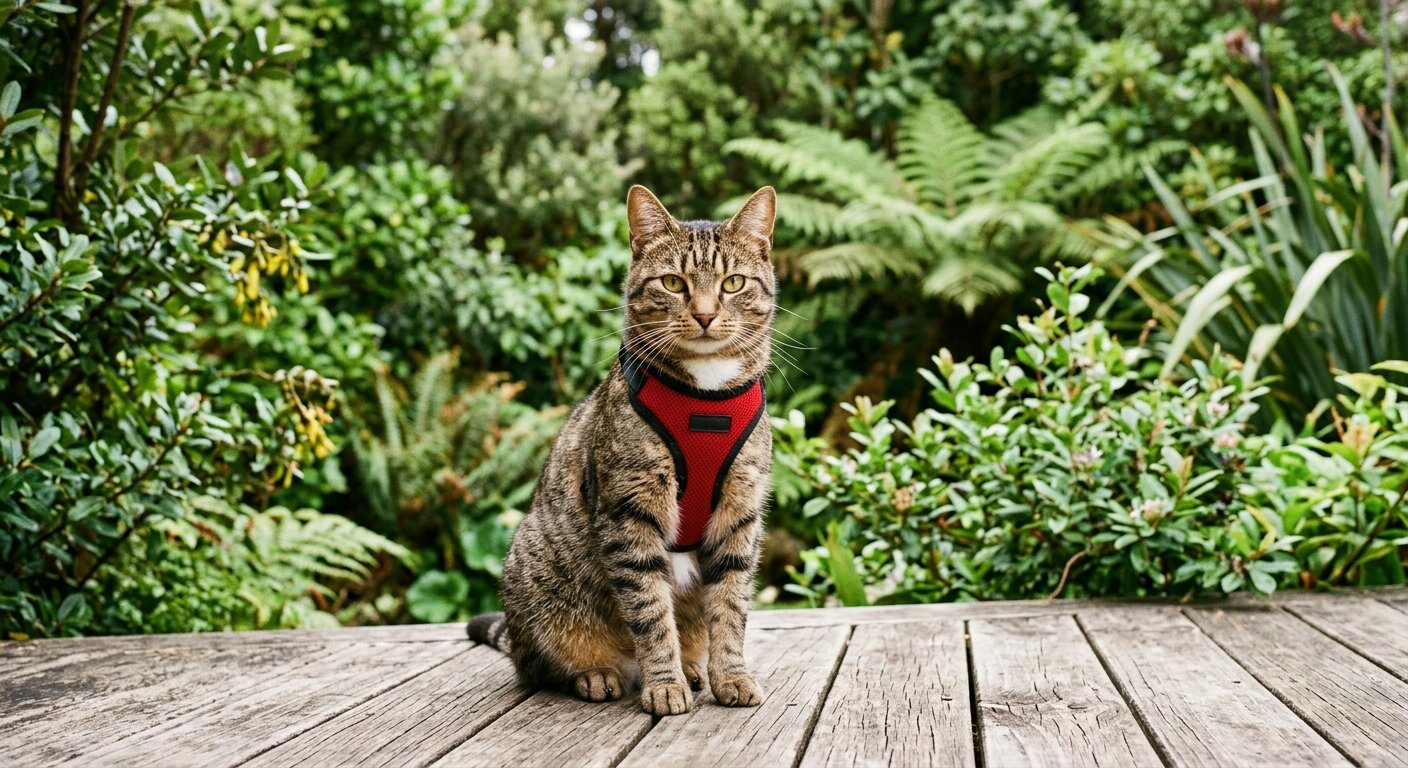
Independent review of the best cat harnesses available in New Zealand — escape-proof jacket harnesses, H-style options, and everything you need to start leash training your cat. NZ pricing and honest recommendations.
The short version
Jacket-style vest harnesses are the right choice for cats. They’re harder to escape from than H-style harnesses and distribute pressure more evenly. The Rabbitgoo Cat Harness is the most available jacket-style option in NZ and a solid starting point for most cats. For smaller or long-haired cats, a Mynwood Cat Walking Jacket gives you a better fit.
H-style harnesses (figure-8 shape) are cheaper and easier to find, but confident cats can back out of them. If your cat is calm and you’re doing indoor garden walks only, an H-style works fine. If you’re going anywhere unpredictable, use a vest.
Why cat walking is growing in NZ
Cat walking on a lead has become meaningfully more common in New Zealand, driven by the same thing that’s increasing indoor cat ownership: council bylaws protecting native wildlife. Cats living under curfew or indoor restrictions can still get outside time and environmental enrichment — just supervised.
The other driver is cat welfare research, which has gotten clearer about the benefits of outdoor stimulation even for indoor cats. The mental health benefits of outdoor sniff sessions, terrain exploration, and controlled novelty are real and measurable in behaviour. Cats who get regular supervised outside time show lower anxiety markers than those who don’t.
A harness-trained cat can access outdoor enrichment without becoming a wildlife threat. It’s worth the adjustment period. If your cat is fully indoor between walks, pair the harness plan with enrichment from the best interactive cat toys NZ guide and a secure retreat like a cat tree.
Types of cat harnesses
Jacket/vest harness
A fabric panel covering the chest and back, with straps securing around the belly and neck.
- Pros: Most escape-proof design, distributes pressure well, comfortable for longer wear
- Cons: Takes longer to put on than H-style, more to adjust for a correct fit
- Best for: Outdoor walks, nervous cats, cats that have escaped other harnesses; also the safest choice when walking to the car before using a cat carrier
H-style harness
Two loops — one around the neck, one around the chest — connected by a strap across the back.
- Pros: Quick to put on, widely available, inexpensive
- Cons: Escape-prone, neck loop can put pressure on throat if cat pulls or panics
- Best for: Short garden sessions, calm cats, first-time harness introduction
Cat steps into two circles that form a figure-8, tightening slightly when pulling.
- Pros: Easy to fit
- Cons: Limited adjustability, some cats escape by going completely limp
- Best for: Docile cats, brief outdoor exposure
Top picks
🥇 Best overall: Rabbitgoo Cat Harness (Vest/Jacket style)
- Type: Adjustable mesh vest
- Price: ~$25–35 NZ
- Available at: Amazon NZ, PetDirect, some Animates stores
- Best for: Most adult cats doing regular outdoor walks
The Rabbitgoo has become the default recommendation because it’s the most widely available jacket-style harness in NZ with a proven track record on escape prevention. Adjustable at neck and belly independently, with a velcro chest panel and buckle belly strap — two independent securing points is the key feature.
The mesh construction is lightweight and doesn’t restrict movement significantly. Cats accept it faster than heavier fabric options. The D-ring for lead attachment sits between the shoulder blades rather than at the neck, which gives you better steering and removes neck pressure.
Fit the belly strap snugly. This is the failure point most owners get wrong — they leave it loose because it looks more comfortable, then the cat backs out. You should fit two fingers comfortably under the belly strap and no more.
🥈 Best for small or long-haired cats: Mynwood Cat Walking Jacket
- Type: Knitted nylon walking jacket
- Price: ~$40–55 NZ (imported)
- Available at: Online import (UK-based, ships to NZ), some specialty stores
- Best for: Slim, small, or long-haired cats where standard sizing doesn’t fit well
The Mynwood is a UK product that ships internationally and has strong word-of-mouth in NZ cat communities. It wraps around the cat more completely than typical vest harnesses, making it genuinely difficult to escape even for cats who’ve backed out of everything else.
The sizing is more precise and the material gives slightly under load rather than being rigid, which some cats accept faster. Worth considering if you have a Siamese or other slender-framed breed where standard sizing gaps around the chest.
Import time from the UK is 10–20 days depending on customs.
🥉 Best budget: PetSafe Come With Me Kitty Harness
- Type: H-style with bungee lead
- Price: ~$20–30 NZ
- Available at: Animates, PetStock, PetDirect
- Best for: First-time harness trial, calm indoor cats, garden supervision
The most widely stocked cat harness at NZ pet chains. Comes with a bungee-style lead that absorbs sudden movement without jerking — useful because cats move laterally and stop suddenly in ways that would put hard force on a standard lead.
Adequate for calm, relatively docile cats in low-risk environments. If your cat has ever bolted or panicked outside, go for the vest option instead. The H-style can be escaped by a determined cat, particularly if they back up and flatten simultaneously.
The bungee lead included is one of the better cat-specific leads available locally — even if you upgrade the harness, the lead is worth keeping.
Best for kittens: RC Pets Compass Kitty Harness
- Type: Adjustable H-style
- Price: ~$20–25 NZ
- Available at: Specialty pet stores, online
- Best for: Kittens and small cats building harness tolerance
Wide adjustment range accommodates rapid growth in kittens. The material is softer than most budget options — important for kittens whose skin is more sensitive to rubbing. Worth sizing up as your kitten grows rather than using this as the permanent solution; transition to a vest-style at adult size.
Starting harness training young makes the adjustment period significantly shorter. A kitten introduced to a harness at 10–12 weeks will usually accept outdoor walking by four to five months.
Getting your cat walking — a realistic timeline
Week 1–2: Harness at home
Leave the harness near your cat’s sleeping area. Let them investigate, sit on it, ignore it. Then start putting it on for 5 minutes, reward, remove. No lead, no pressure, no outdoor access yet. Extend to 10, then 20 minutes. The goal is a cat who is indifferent to wearing the harness inside.
Week 3–4: Lead introduction
Attach the lead but don’t hold it — let the cat drag it around inside while supervised. The sensation of something following them is what cats need to normalise, not just the harness. Once they ignore the trailing lead, pick it up and follow without applying pressure.
Week 5+: First outdoor sessions
Start in a quiet outdoor area, ideally your own garden if you have one. Don’t pull or steer — follow your cat. The first sessions are about letting them process the environment at their own pace. Five to ten minutes outdoors is plenty to start, and make sure flea prevention is current before regular garden sessions — see the cat flea treatment NZ guide.
Some cats progress faster. Some take longer. The cats that rush the process by being taken out before they’re comfortable with the indoor stages tend to have bad experiences that set training back. A calm home base helps too — the best cat bed NZ picks are useful if your cat needs a predictable reset spot after training.
What to avoid
Retractable leads: Too much slack, no reliable snub point if something frightens the cat. Fixed lead only.
Collar-and-lead combinations: A panicking cat can back out of a collar completely. Always use a harness. If you do want your cat to wear a collar for ID purposes when outdoors, see our guide to the best cat collar in NZ — but keep it separate from your walking setup.
H-style for outdoor walking: Fine for garden time, but not for streets, parks, or anywhere another dog or animal could appear. The escape risk is real.
Sizing by weight alone: Some harnesses list weight ranges; always cross-check with the chest circumference measurement. Cat body shapes vary considerably — an Abyssinian and a British Shorthair at the same weight have very different chest measurements.
NZ prices and where to buy
| Harness | Type | Price (NZ) |
|---|
| Rabbitgoo Cat Harness | Jacket/vest | $25–35 |
| Mynwood Walking Jacket | Jacket (imported) | $40–55 |
| PetSafe Come With Me Kitty | H-style + lead | $20–30 |
| RC Pets Compass Kitty | H-style (kitten) | $20–25 |
NZ pricing, April 2026. Import pricing varies with exchange rate.
Where to buy in NZ:
- Animates / PetStock — PetSafe and basic H-style options most reliably stocked
- PetDirect — wider online range including vest styles
- Amazon NZ — Rabbitgoo and similar vest options available with reasonable delivery
- Specialty pet and cat stores — often stock higher-quality options not found at chains
Last reviewed April 2026. Start harness training before you need it — a cat who’s never worn one at home won’t tolerate it outside.
 PawPick