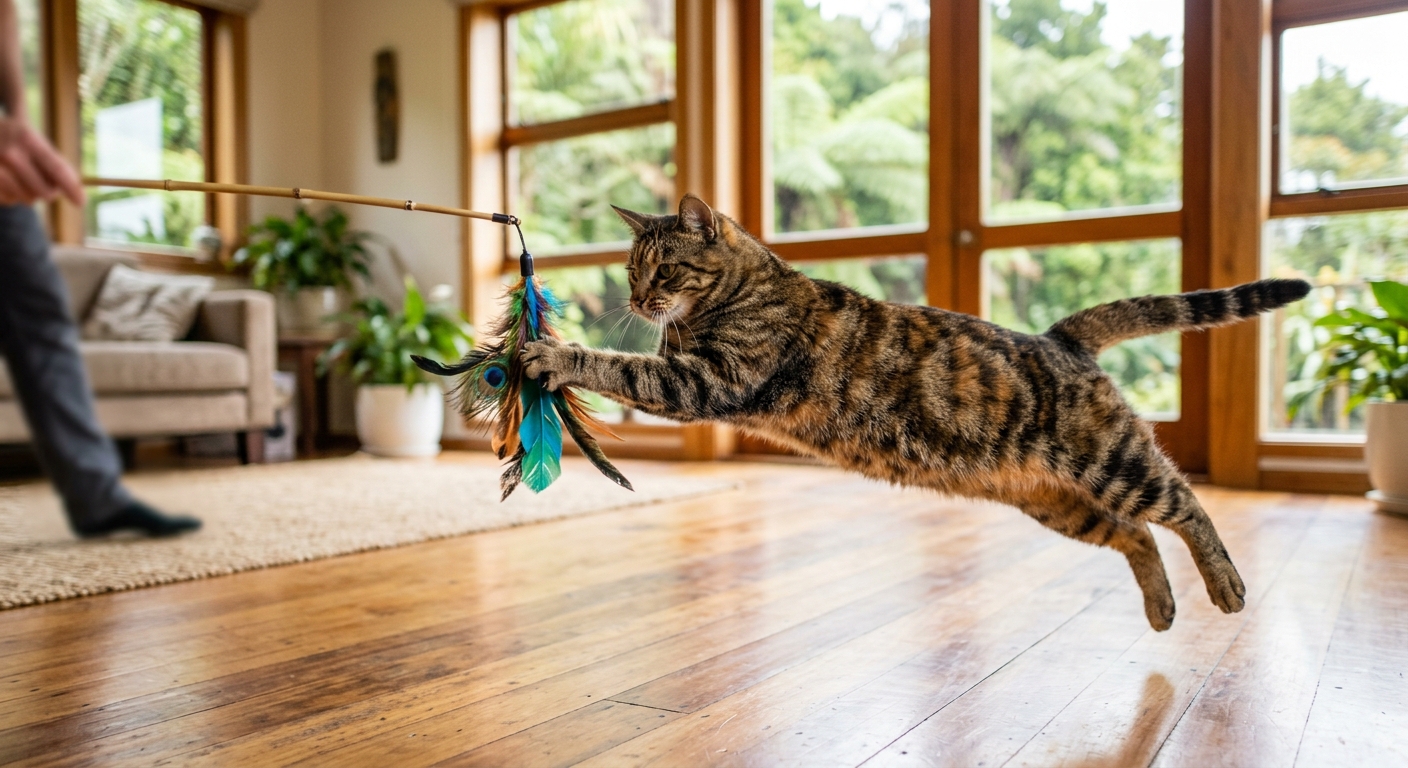
The best interactive cat toys in New Zealand — feather wands to electronic teasers tested. Find which toys keep indoor cats entertained with NZ pricing.
The short version
Buy a Da Bird feather wand for interactive sessions, and a SmartyKat Hot Pursuit for solo play. Those two cover most of what an indoor cat needs. Add a Catit Senses Play Circuit if you have a high-energy cat or more than one — they’re cheap, durable, and cats actually use them.
Everything below is the reasoning, the options, and honest notes on what works versus what looks good in product photos.
Why interactive play matters for indoor cats
More NZ cats are living indoors — council bylaws protecting native wildlife are becoming standard in cities, and plenty of owners are making the call voluntarily. That’s good for birdlife. For cats, it removes the environmental stimulation they’d otherwise get from patrolling, hunting, and navigating territory.
An indoor cat without adequate play can become overweight, bored, or anxious. The first sign is usually weight gain — indoor cats have lower energy needs but often eat the same as outdoor cats. The second is destructive or attention-seeking behaviour: knocking things off surfaces, excessive vocalisation, or pestering you at 3am.
Interactive toys solve this, but only if you actually use them. The $80 electronic gadget that lives in a drawer is worse than a $12 wand you use every evening.
Types of interactive toys
Wand and teaser toys
A stick with string attached to a lure — feathers, fabric, foil, or ribbon. Controlled by you.
- Pros: Highly engaging, mimics prey movement, adjustable intensity, good exercise
- Cons: Requires you to be present and actively involved
- Best for: Daily interactive sessions, bonding, high-energy cats
These are the most effective cat toys, full stop. No electronic toy replicates the unpredictable, reactive movement of a hand-held wand because your cat is hunting you as much as the lure. The relationship between cat and prey is live.
Electronic automated toys
Battery or USB powered toys that move independently — rotating wands, flickering lights under fabric, rolling balls.
- Pros: Cat can play solo, no human required
- Cons: Cats figure out the pattern quickly and disengage, requires battery replacement/charging, can malfunction
- Best for: Supplementing human play, not replacing it
Circuit and track toys
Balls trapped inside a circuit track that cats bat and chase.
- Pros: Durable, simple, no batteries, cats can return to them independently
- Cons: Low engagement ceiling — good for ten minutes, not fifty
- Best for: Environmental enrichment, multi-cat households, solo play option
Puzzle feeders
Toys that dispense food or treats as cats interact with them.
- Pros: Combines feeding and play, great mental stimulation, slows eating
- Cons: Not exercise, requires calibration to your cat’s ability level
- Best for: Cats who eat too fast, indoor cats prone to weight gain
Top picks
🥇 Best wand toy: Da Bird Feather Wand
- Type: Wand with swivel feather attachment
- Price: ~$20–25 NZ
- Available at: PetDirect, specialty pet stores, online
If you own one cat toy, make it this one. The Da Bird uses a swivel attachment that makes feathers rotate realistically as they move through air — it sounds like a bird in flight, which is what makes cats lose their minds about it.
Pōhu — who normally views most toys with the energy of a consultant reading meeting minutes — charged this thing with genuine urgency the first time I used it. The response is consistently stronger than other wand toys because the movement and the sound together trigger the hunt instinct more completely.
The rod and handle are separate from the attachment, so when feathers inevitably get destroyed (and they will — that’s the point), you can buy replacement attachments rather than the whole thing. Spare attachments cost around $8–12. Budget for them.
Pro tip: Move it like prey, not like a toy. Drag it slowly along the floor, pause, twitch it suddenly, run it behind furniture. The unpredictability keeps cats engaged far longer than just waving it through the air.
🥈 Best electronic toy: SmartyKat Hot Pursuit
- Type: Electronic undercover rotating wand
- Price: ~$35–45 NZ
- Available at: Animates, PetStock, PetDirect
A motor rotates a wand with a feather tip under a fabric cover, creating random-speed movement that cats can see but can’t predict. The undercover element is key — the toy moves like something hiding, which triggers ambush-hunting behaviour in cats who might otherwise disengage from visible electronic toys.
The speed settings cycle through slow and fast at randomised intervals, which matters — consistent speed is what cats habituate to and ignore. The randomisation keeps them engaged through a session rather than for the first thirty seconds.
Battery life isn’t great, and the fabric cover eventually tears if your cat is enthusiastic. Replacement fabric covers aren’t always easy to source in NZ, but the base unit is reasonably durable. Turn it off between sessions — cats ignore it once they’ve identified the pattern.
🥉 Best circuit toy: Catit Senses Play Circuit
- Type: Modular ball-track circuit
- Price: ~$30–40 NZ (starter set)
- Available at: Animates, PetStock, PetDirect, Pet Circle
A modular track system with a ball cats can bat but can’t extract, combined with a illuminated wave section that adds unpredictability. The modular design means you can rearrange the layout periodically to reset novelty, which extends useful life considerably.
This isn’t going to hold a cat’s attention for long stretches, but it doesn’t need to. It’s the toy a cat wanders over to when you’re not available — something to do at 2am that isn’t your face. In a multi-cat household, it’s also a useful solo option while you’re doing directed play with another cat.
Durable, no batteries required for the basic circuit (the wave section has LEDs), easy to clean.
Best budget pick: Crinkle balls and foil balls
- Price: $5–10 for a pack
- Available at: Any pet store, some supermarkets
I’m listing this because the truth is that crinkle balls and scrunched foil balls often outperform $40 electronic toys in daily use. They’re lightweight, skitter unpredictably across floor surfaces, make noise when batted, and are cheap enough that losing them under the couch is a minor inconvenience rather than an investment loss.
Some cats bat elaborate electronic toys twice, then spend thirty minutes destroying a crinkle ball. If your cat is like this, lean into it. Enrichment isn’t about the price.
Best for mental stimulation: Catit Senses Digger
- Type: Puzzle feeder
- Price: ~$25–35 NZ
- Available at: Animates, PetDirect, Pet Circle
Tubes of varying depths that cats must reach into to retrieve kibble or treats. Simple enough that most cats figure it out, complex enough that it takes time and thought. Works particularly well if you’re feeding dry kibble — you can put a portion of the daily meal in the digger and let your cat work for it rather than eating from a bowl in thirty seconds.
Cats who eat too fast or are prone to vomiting after meals often do better on puzzle feeders. The slower pace of eating reduces the trigger for post-meal regurgitation.
Best laser option: Frolicat Bolt interactive laser
- Type: Automated laser toy
- Price: ~$30–40 NZ
- Available at: Animates, PetDirect, online
If you’re going to use a laser toy, use it properly: always end the session by transitioning to a physical toy your cat can catch. The Bolt has an auto-rotate feature and timer that turns it off after 15 minutes, which is appropriate. It mounts on a flat surface or clamps to a table edge.
I keep this one lower on the list not because it doesn’t work, but because the frustration risk is real if you don’t follow the session-ending protocol. Used correctly — laser session, then feather wand catchable prey — it’s fine. Used as a standalone toy without resolution, you’ll notice your cat becoming more anxious or twitchy over time.
What to avoid
Single-texture rope toys and plush mice: Cats investigate them once and move on. They have no movement component. Fine as part of a pile of toys, but don’t buy them expecting sustained engagement.
Overly complex automatic toys: Anything with more than two moving parts tends to jam, confuse cats, or break quickly. Simple mechanisms outlast elaborate ones.
Toys sized for dogs: Some circuit tracks and puzzle feeders marketed as “for pets” are actually sized for dogs. Check the ball or paw opening size — cats need smaller gaps and narrower tubes.
Making existing toys work harder
The single most effective technique for extending toy life is rotation. Put most toys away and make two or three available at a time. Rotate the visible selection every few days. A toy that’s been in a drawer for a week is noticeably fresher to a cat than one that’s been on the floor continuously.
Catnip resets interest in familiar toys reliably. Rub fresh dried catnip onto a toy that’s lost appeal, leave it for thirty minutes, and reintroduce it. Works on roughly 70% of cats — catnip sensitivity is genetic and not universal.
Play timing matters. Most cats are most active at dawn and dusk — these are the sessions where you’ll get the most engagement and the most exercise. If you want to stop the 5am wake-up calls, a genuine 15-minute play session at 10pm will make a bigger difference than any other intervention.
NZ prices and where to buy
| Toy | Type | Price (NZ) |
|---|
| Da Bird Feather Wand | Wand toy | $20–25 |
| SmartyKat Hot Pursuit | Electronic automated | $35–45 |
| Catit Senses Play Circuit | Circuit track | $30–40 |
| Catit Senses Digger | Puzzle feeder | $25–35 |
| Frolicat Bolt | Laser | $30–40 |
| Crinkle/foil balls (pack) | Simple toys | $5–10 |
NZ pricing, April 2026. Varies by retailer and sale.
Where to buy in NZ:
- Animates / PetStock — most SKUs in stock, good for checking sizing in person
- PetDirect — best pricing on bulk replacements and online orders
- Pet Circle — ships from Australia, free delivery over $49; good for less common brands
The decision
- You want one toy that actually works → Da Bird feather wand
- You need something that runs without you → SmartyKat Hot Pursuit
- High-energy cat or multi-cat household → Catit Senses Play Circuit + wand combo
- Cat eats too fast or needs mental engagement → Catit Senses Digger
- Tight budget → Crinkle balls, seriously
- Kitten under 12 months → Wand toy for active sessions, crinkle balls for solo; kittens don’t need complex toys
Two sessions a day, 10–15 minutes each, with a wand toy. That covers the basics. Everything else is supplemental.
Related guides:
Last reviewed April 2026.
 PawPick