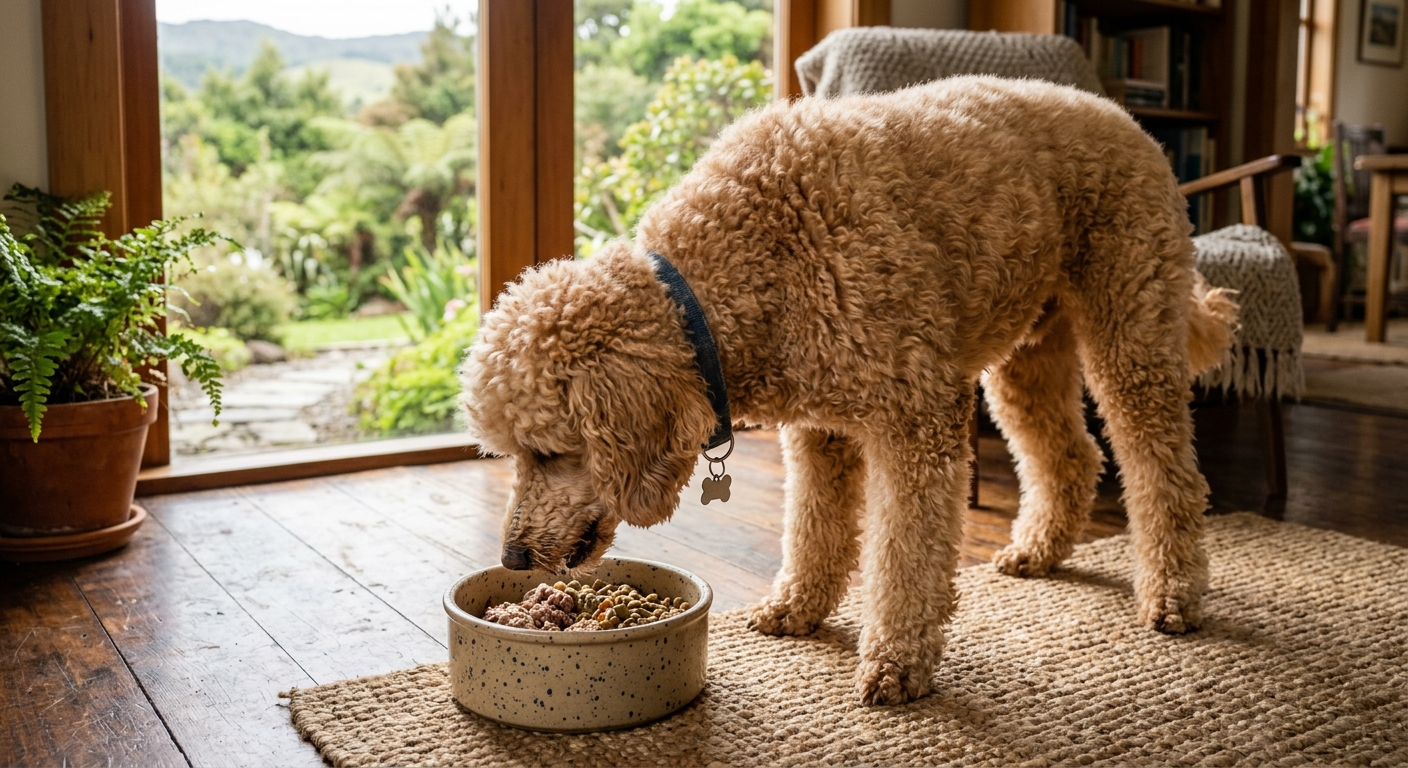
Poodles — Standard, Miniature, and Toy — each have specific feeding needs. We compare the best dog foods for Poodles available in New Zealand, covering coat health, skin conditions, bloat prevention, and realistic NZ pricing.
The short version
Black Hawk Adult Lamb & Rice handles most adult Poodles well — good protein, fish oil for that coat, no unnecessary fillers, and available nationwide. For Standard Poodles showing joint wear or any Poodle with skin or coat problems, Ivory Coat Lamb & Sardine delivers the omega-3s that this breed genuinely needs. Sebaceous adenitis or confirmed sensitivities? Go straight to ZIWI Peak Lamb — single protein, green-lipped mussel, nothing to hide in the ingredient list.
Toy Poodle owners: kibble size and calorie density matter more than for the bigger variants. Small-breed formulas only. Standard Poodle owners: take the bloat risk seriously — two meals a day, no vigorous exercise around feeding, slow-feeder bowl.
Start here if you have not chosen a brand yet: this breed guide narrows the decision for one type of dog. For the overall brand shortlist, budgets, and retailer comparison, use the main best dog food in NZ guide first.
Price-check the main picks
PawPick uses already-approved merchant links only. If a breed pick overlaps one of these VetSupply ranges, use it as an AU price check, then compare NZ stock, bag size, shipping, and your dog’s needs before buying:
Why Poodles need more thought than their reputation suggests
Poodles are often treated as low-maintenance because they don’t shed. The coat is actually the opposite of low-maintenance — and what goes into the dog has a direct effect on what comes out of those follicles.
- Sebaceous adenitis. A skin condition found at higher rates in Standard Poodles (and to a lesser extent Miniatures) where the sebaceous glands become inflamed and eventually destroyed. It causes scaling, hair loss, and a characteristic musty odour. Diet doesn’t cause it — but omega-3s, zinc, and quality protein all influence how severely it presents. Some owners manage mild SA entirely through diet and topical oil treatments; others need vet medication. Either way, food matters.
- The coat demands nutrients. Poodle hair grows continuously, which means it’s drawing on protein, zinc, and fatty acids constantly. A dull, brittle, or thinning coat on a Poodle is almost always nutritional before it’s anything else.
- Bloat risk in Standards. Gastric dilatation-volvulus (GDV) — bloat — kills deep-chested dogs, and Standard Poodles are in that risk category. The connection to food is imperfect, but feeding practices (one large meal, vigorous exercise around feeding, eating too fast) are consistently associated with risk. This one warrants actual behavioural change, not just food choice.
- Three very different dogs under one name. A Standard Poodle at 28 kg and a Toy Poodle at 3 kg have almost nothing in common nutritionally except the breed name. What applies to one may actively be wrong for the other.
- Toy Poodle hypoglycaemia. Very small dogs have very small fuel reserves. Toy Poodle puppies and young adults — particularly those under 2 kg — can drop blood sugar dangerously between meals. Frequent feeding (three times a day minimum for puppies) and calorie-dense food are not optional.
What to look for
Protein
Named animal protein as the first ingredient. Lamb, fish, and venison are the cleaner choices for Poodles with any history of skin or gut sensitivity — chicken and beef are more common triggers. Aim for 24–30% protein for adults. Higher isn’t better; excess protein adds calories without adding coat benefit.
Omega-3 fatty acids
For this breed, this deserves more attention than almost anything else on the label:
- EPA and DHA from fish oil — directly supports skin barrier function and coat condition. Look for whole fish in the ingredients, not just “added oil”
- Zinc — works alongside fatty acids in skin health; often low in generic dry foods
- Green-lipped mussel — a NZ ingredient with high levels of glycosaminoglycans and omega-3s. Standard Poodles benefit from joint support from middle age; the mussel delivers both
Kibble size
Toy Poodles cannot eat standard kibble comfortably. Small-breed kibble is more than a gimmick — it reduces gulping, choking, and dental wear from awkward chewing. For Miniature and Standard Poodles, regular kibble is fine.
Calorie density by variant
- Standard Poodle (20–32 kg): moderate fat (12–16%), two meals a day
- Miniature Poodle (5–9 kg): standard small-to-medium breed, moderate calorie density
- Toy Poodle (2–4 kg): higher calorie density per gram is valuable — small stomachs mean small portions, and the dog needs to get enough from them
What to avoid
- Mystery meat meals — “meat meal” or “animal digest” without a named species is usually a quality signal worth heeding in a coat-dependent breed
- Artificial colours, flavours, and BHA/BHT — unnecessary; look for natural preservation (tocopherols/vitamin E)
- Grain-free without a reason — there’s no coat benefit from grain-free in a breed without confirmed grain sensitivity, and some grain-free formulas have been associated with dilated cardiomyopathy (DCM)
The picks
Best all-round: Black Hawk Adult Lamb & Rice
Lamb as the primary protein, rice as the grain, added fish oil — covers the main nutritional bases for most Poodle variants at a realistic price. It’s widely stocked at Animates and PetStock and provides consistent quality without filler proteins. The fish oil content supports coat health, though for Poodles with active skin issues, it may not be sufficient on its own — pair with an omega-3 supplement or switch to Ivory Coat Lamb & Sardine.
For Standard Poodles, use the Adult Large or All-Breed variant. For Miniature and Toy Poodles, look for Black Hawk’s Adult Small Breed version with appropriately sized kibble.
- Protein: ~26% | Fat: ~15%
- Daily cost: ~$1.00–1.50 for a 4 kg Miniature; ~$3.00–4.50 for a 28 kg Standard (20 kg bag)
- Where to buy: Animates, PetStock, Pet.co.nz, independent pet stores
For the full breakdown, see our Black Hawk dog food review.
Check price at Pet Direct →
Best for coat and skin: Ivory Coat Lamb & Sardine
The sardine in this formula delivers omega-3 from whole fish, not just added oil — more bioavailable, and directly useful for coat condition and sebaceous adenitis management. The limited ingredient list is an advantage if you suspect sensitivities, and the lamb protein sidesteps the most common allergy triggers. For a Poodle with a dull coat, scaling, or recurring skin irritation, this is the food to try first.
One thing: Ivory Coat has grain-free variants. Unless your vet has a specific reason to recommend grain-free, choose the grain-inclusive option.
- Protein: ~28% | Fat: ~14%
- Daily cost: ~$1.50–2.00 for a 4 kg Miniature; ~$3.50–5.00 for a 28 kg Standard
- Where to buy: Animates, selected PetStock, online retailers
Full breakdown: Ivory Coat dog food review.
Check price at Pet Direct →
Best premium: ZIWI Peak Lamb
Made in New Zealand from NZ lamb, naturally including green-lipped mussel, organs, and bone — no grains, no fillers, no mystery proteins. For Poodles with confirmed sensitivities, sebaceous adenitis, or simply owners who want the cleanest possible ingredient list, this is as good as commercial dog food gets in NZ. The green-lipped mussel provides joint support for Standards and anti-inflammatory omega-3s for skin conditions simultaneously.
The honest conversation is cost. A 4 kg Miniature Poodle needs around 60–70g/day of ZIWI air-dried, which works out to roughly $3.50–4.50/day. A 28 kg Standard needs roughly $9–14/day — around $270–420/month. Many Poodle owners use ZIWI as a topper on kibble (a tablespoon over Black Hawk, for example) to capture the skin and coat benefits at a fraction of the full-feed price. That’s a sensible approach.
- Protein: ~38% | Fat: ~26%
- Where to buy: Animates, PetStock, Pet.co.nz, specialty stores, direct from ZIWI
See our ZIWI Peak dog food review for the full picture.
Best for Toy Poodles: Advance Adult Toy Breed
Toy Poodle owners need small kibble that also delivers enough calorie density in small portions. Advance’s Toy Breed formula is designed for dogs under 5 kg — smaller pieces, higher energy density, and omega-3s for skin and coat. The portion control this allows is important: Toy Poodles have tiny stomachs, and getting enough nutrition in three small daily meals matters.
- Protein: ~26% | Fat: ~16%
- Daily cost: ~$0.70–1.00 for a 3 kg Toy Poodle
- Where to buy: Animates, PetStock, vet clinics
Best for Standard Poodle joints: Advance Adult Large Breed
From middle age, Standard Poodles benefit from added joint support — glucosamine and chondroitin in the recipe rather than as afterthought supplements. Advance Large Breed includes both, with a kibble size appropriate for larger jaws and a calorie profile that suits active adult Standards. For a breed already predisposed to joint problems with age, this is a practical choice at a realistic price.
- Protein: ~25% | Fat: ~14%
- Daily cost: ~$3.00–4.00 for a 28 kg Standard
- Where to buy: Animates, PetStock, some vet clinics
Best for puppies: Advance Puppy Large Breed (Standards) / Black Hawk Puppy (Mini & Toy)
Standard Poodle puppies grow quickly and need the calcium-to-phosphorus ratios in large-breed puppy food, not standard puppy formula. Advance Puppy Large Breed manages this correctly and includes DHA for brain development. Keep Standard Poodles on large-breed puppy food until at least 12–15 months.
For Miniature and Toy puppies, Black Hawk Puppy provides good protein, omega-3s, and calorie density without the large-breed ratio constraints. Toy Poodle puppies in particular need three to four meals a day until six months of age to prevent hypoglycaemia.
See our best puppy food in NZ guide for how the full range compares.
How much to feed
Feeding amounts vary significantly across Poodle variants. Use these as starting points and adjust based on body condition every 2–4 weeks.
Standard Poodle (adult, 20–32 kg)
| Weight | Activity level | Daily amount | Approx. daily cost |
|---|
| 20 kg | Low–moderate | 230–280g | $2.30–3.00 |
| 25 kg | Moderate | 280–330g | $2.80–3.50 |
| 28 kg | Active | 320–380g | $3.20–4.00 |
| 32 kg | Very active | 370–430g | $3.70–4.50 |
Split across two meals. Use a slow-feeder bowl. Do not allow vigorous exercise for at least 60 minutes before and after meals — this matters more for Standard Poodles than almost any other breed.
Miniature Poodle (adult, 5–9 kg)
| Weight | Activity level | Daily amount | Approx. daily cost |
|---|
| 5 kg | Low–moderate | 70–90g | $0.80–1.10 |
| 7 kg | Moderate | 100–120g | $1.00–1.40 |
| 9 kg | Active | 130–150g | $1.30–1.70 |
Two meals a day suits most adult Miniatures.
Toy Poodle (adult, 2–4 kg)
| Weight | Activity level | Daily amount | Approx. daily cost |
|---|
| 2 kg | Low–moderate | 35–45g | $0.50–0.70 |
| 3 kg | Moderate | 50–65g | $0.65–0.90 |
| 4 kg | Active | 70–85g | $0.85–1.10 |
Three meals a day is better than two for Toy Poodles, particularly in the first two years.
Bloat and Standard Poodles
Bloat (GDV) is a genuine risk for Standard Poodles — deep-chested breeds are overrepresented in emergency statistics. It’s fast, life-threatening, and kills within hours if untreated.
The feeding practices consistently associated with lower risk:
- Two meals, not one. Never feed one large meal per day.
- Slow-feeder bowl. Eating fast and swallowing air is part of the mechanism.
- No vigorous exercise within 60 minutes of meals — both before and after.
- Raised bowls are no longer considered protective — the research on this shifted; ground level is fine.
- Watch for symptoms: unsuccessful retching, distended abdomen, restlessness, drooling. This is a vet emergency. Don’t wait.
Prophylactic gastropexy — surgically tacking the stomach to the abdominal wall — can be done when desexing and is worth discussing with your vet if you own a Standard Poodle. It prevents GDV without affecting normal eating and digestion.
Managing sebaceous adenitis through diet
Sebaceous adenitis (SA) in Poodles isn’t curable, but diet is one of the variables you can actually control:
- Omega-3 fatty acids (EPA and DHA from fish) reduce sebaceous gland inflammation. If your food doesn’t include whole fish, supplementing with fish oil or a krill oil product makes a measurable difference for some dogs. See my best pet supplements in NZ guide for well-formulated NZ-available options.
- Zinc — often deficient in dogs with SA and in poor-quality dry foods generally. Check the mineral profile or consider a supplement under vet guidance.
- High-quality protein — the coat depends on amino acids. Cheap food with poor protein digestibility shows up in the coat first.
- Evening primrose oil — some NZ vets use this topically and as a supplement for SA management; anecdotal evidence is reasonably consistent even if the formal research is thin.
SA confirmed by biopsy warrants a vet conversation about treatment. Diet alone won’t control moderate-to-severe cases. But in mild presentations, and as adjunct support for dogs on medication, it genuinely helps.
Common feeding mistakes
1. Using the same food for Standard and Toy Poodles.
They’re the same breed in name. They’re not the same dog nutritionally. Kibble size, calorie density, portion size, and meal frequency all differ meaningfully.
2. Ignoring coat condition as a nutritional signal.
A Poodle’s coat deteriorates before anything else when nutrition is insufficient. If the coat looks or feels wrong, look at omega-3 content in the food before assuming a skin condition.
3. Underfeeding Toy Poodles because they’re small.
Small doesn’t mean less demanding. Toy Poodles have fast metabolisms and minimal fat reserves. Under three meals a day in the first year risks hypoglycaemia.
4. One large meal for Standard Poodles.
Two meals a day is not a preference for Standard Poodles — it’s a bloat risk reduction strategy. One large meal is one of the most consistently cited feeding risk factors.
5. Going grain-free because the coat looks rough.
Grain-free has no proven coat benefit in dogs without grain sensitivity. The DCM risk it introduces is not worth taking on a guess. Fix the omega-3s first. If you do have a confirmed grain sensitivity, my best grain-free dog food in NZ guide will help you choose options that don’t rely heavily on legumes — especially important for a DCM-predisposed breed.
What about raw?
Poodles can do well on raw, particularly for allergy management and SA. A 7 kg Miniature needs roughly 140–175g/day; a 28 kg Standard needs roughly 560–700g/day.
If you’re considering it:
- Start with a single protein — lamb or fish if coat or skin is the concern
- Commercially balanced raw is safer than DIY, particularly for managing the calcium-to-phosphorus ratios in puppies
- Budget roughly $3–7/day for Miniatures; $9–15/day for Standards depending on brand
- Talk to your vet first — especially for puppies or dogs being managed for SA
NZ options include K9 Natural (freeze-dried, widely available), Kiwi Kitchens (NZ-made, affordable raw-coated kibble), and Raw Essentials with stores across the country. Raw-fed dogs also need more frequent worming as raw meat increases tapeworm exposure.
Best dog food by breed
Start with the main best dog food in NZ guide for the all-breed shortlist, then use these breed guides to adjust for size, weight, coat, digestion, and joint risk:
- Labrador Retriever — weight control, joint support, and measured meals.
- Golden Retriever — joint support, coat health, and sensible calories.
- Staffordshire Bull Terrier — muscle maintenance, skin support, and realistic budgets.
- French Bulldog — digestion, allergy triggers, and flat-face feeding.
- Border Collie — high-energy working-dog nutrition.
- German Shepherd — hip, joint, and digestive support.
- Poodle — you’re here; this guide covers coat, digestion, and size-specific feeding.
- Cavalier King Charles Spaniel — heart-aware feeding and weight management.
- Pug — weight control, skin folds, and flat-face kibble.
- Husky — high-protein fuel for active, lean dogs.
 PawPick