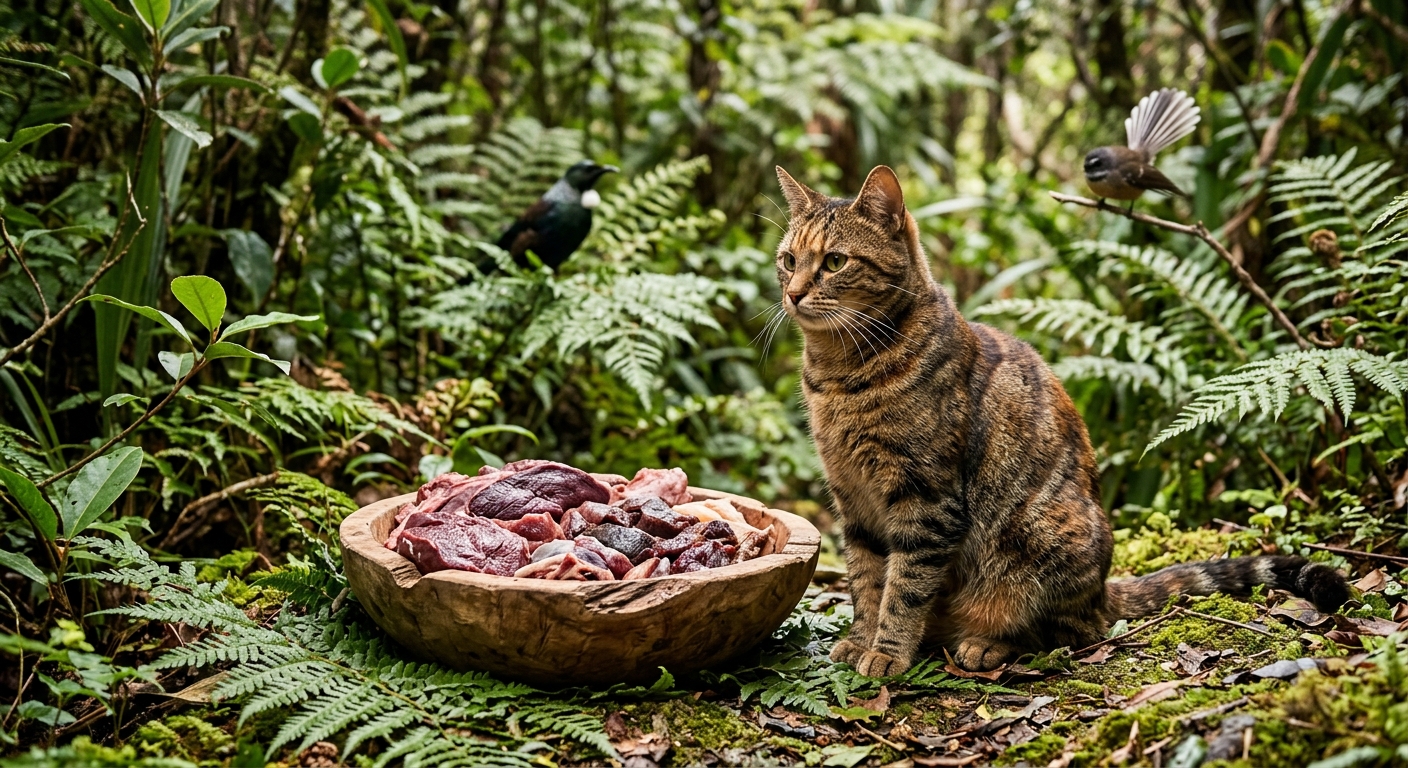
Best raw cat food NZ guide — ZIWI Peak and Feline Natural are the safest starting points; Raw Essentials is the main full-raw option for committed owners.
The short version
The best raw cat food starting point in NZ is ZIWI Peak air-dried or Feline Natural freeze-dried raw — both are NZ-made, widely available, and lower-risk than fresh or frozen raw. If you are ready for full raw feeding and the hygiene work that comes with it, Raw Essentials is the most established specialist option.
Big Dog raw is worth considering if you want a lower-cost frozen raw product stocked at mainstream pet stores. DIY prey-model feeding is an option for experienced owners, but requires solid nutritional knowledge to do safely.
The honest caveat: raw feeding is not a simple upgrade over high-quality commercial food. It carries genuine food safety responsibilities and is not suitable for all cats or all households. This guide covers the options clearly so you can decide whether it’s right for your situation.
For the broader cat food picture, start with our best cat food NZ guide. If you’re weighing up wet food versus dry first, see our wet vs dry cat food comparison.
Raw and raw-adjacent quick picks
| Need |
Best pick |
Why this one |
Where to buy |
| Safest raw-adjacent start |
ZIWI Peak air-dried |
NZ-made, shelf-stable and widely stocked; raw-style nutrition without fresh-raw handling. |
Check ZIWI Peak at VetSupply → |
| Freeze-dried raw |
Feline Natural freeze-dried |
The strongest NZ-made freeze-dried option, but no verified direct joined-merchant SKU today. |
PetDirect, Animates or Petstock; no honest affiliate CTA until stock is verified. |
| Full frozen raw |
Raw Essentials |
Specialist NZ raw-feeding stores and delivery, not a generic pet-store product. |
Raw Essentials direct; unmonetised for now. |
Affiliate coverage check: VetSupply has a ZIWI Peak brand page and a raw-cat-food category, but no verified Feline Natural or Raw Essentials direct SKU in PawPick's joined merchant set. So this guide gets one honest monetised CTA and should stay on the pruning watchlist only if raw-cat traffic continues without ZIWI clicks. Product-pack images were not added because PawPick has no verified licensed pack shots for these SKUs.
Why raw? What cats actually need
Cats are obligate carnivores. Unlike dogs, they cannot synthesise certain nutrients — taurine, arachidonic acid, vitamin A from plant sources — from anything other than animal tissue. Their digestive systems are short, their stomach acid is highly concentrated, and their natural prey (small rodents, birds) is roughly 70% moisture, 15–20% protein, 5–10% fat, and almost zero carbohydrate.
The case for raw feeding rests on this biology: commercial dry food, even good-quality kibble, requires significant starch to hold the pellet together. That starch introduces carbohydrates that cats metabolise poorly. High-quality wet food closes much of this gap. Raw food — particularly prey-model or high-quality commercial raw — closes it further still.
What raw advocates point to:
- Higher moisture content — closer to ancestral prey than any dry food
- No processing heat — some heat-sensitive nutrients (certain B vitamins, enzymes) are preserved
- Low or zero carbohydrate content
- Improved stool quality (smaller, firmer, less odour) — a reliable reported outcome from raw-fed cats
- Coat and skin condition improvements reported by many owners
What the research actually shows: The evidence base for raw feeding in cats is thinner than proponents suggest. Many claimed benefits are observational rather than controlled. NZ vets generally take a cautious position — not universally opposed to raw, but noting the genuine food safety risks and the difficulty of ensuring complete nutrition without professional formulation. Talk to your vet before starting a raw diet, particularly if your cat is older, has any chronic health conditions, or lives with immunocompromised people.
Raw feeding is not a cure-all. A well-formulated high-quality wet food like Feline Natural canned or ZIWI Peak canned provides excellent nutrition without the handling burden. If your cat is thriving on a quality commercial diet, there is no compelling evidence-based reason to switch. If you have specific reasons to explore raw — a cat with chronic digestive issues, food allergies, or simply a strong preference from an informed position — this guide will help you do it safely.
Types of raw cat food: what’s available in NZ
Prey-model raw (DIY)
The most “ancestral” approach — feeding whole prey or a combination of muscle meat, organ meat (particularly liver), and raw meaty bones to replicate what a cat would eat in the wild. A common prey-model ratio is 80% muscle meat, 10% bone (raw, never cooked), 10% organ.
NZ availability: DIY prey-model feeders typically source from butchers, game suppliers, or chicken processors. Some specialty pet food suppliers sell components (chicken frames, chicken hearts, beef liver) directly. There is no shortage of supply, but quality and hygiene vary.
The honest challenge: Getting prey-model nutrition right is harder than it looks. Taurine content varies by protein source. Bone ratios matter for calcium-phosphorus balance. Liver must be included but not overfed (it’s high in vitamin A, which is toxic in excess for cats). Without genuine nutritional knowledge or consultation with a feline nutritionist, DIY prey-model carries real risk of deficiency or toxicity over time. This approach is for experienced owners only.
Commercial raw — fresh and frozen
Pre-formulated raw meals — typically frozen — sold by specialist raw pet food companies. These products are designed to be nutritionally complete without the owner needing to balance ratios manually.
NZ availability: Raw Essentials is the main specialist. Big Dog (an NZ brand) offers frozen raw products at mainstream retailers. These products are held to MPI (Ministry for Primary Industries) regulations on raw meat for animal consumption.
Freeze-dried raw
Raw ingredients that have been flash-frozen then placed in a vacuum chamber where the ice sublimates directly to vapour, removing ~98% of moisture without heat. The result is shelf-stable, lightweight, and — importantly for safety — has significantly lower viable bacterial load than fresh or frozen raw. Many pathogens are killed or reduced in the freeze-drying process, though it is not sterilisation.
NZ availability: Feline Natural freeze-dried raw is the main NZ-made option. Widely available at PetDirect, Animates, and Petstock.
Air-dried raw
Low-temperature drying (around 38–45°C) reduces moisture to around 10% while preserving much of the nutritional profile. At these temperatures, most (but not all) pathogens are killed. Technically, air-dried is not raw — it’s a minimal-heat process. But many owners in the raw-feeding community use it as a practical equivalent.
NZ availability: ZIWI Peak air-dried is the most widely available product in this category in NZ and the best-known brand globally. It’s in most mainstream NZ pet stores and many supermarkets.
Safety: what NZ owners need to know
This section is not optional reading if you’re considering raw feeding.
Bacterial risk
Raw meat — even high-quality, commercially produced raw pet food — can carry Salmonella, Listeria monocytogenes, and Campylobacter. Cats are generally more resistant to these bacteria than humans, but they can shed bacteria in their faeces, contaminating surfaces, hands, and shared spaces.
This is not a theoretical risk. MPI has issued guidance on raw pet food handling, and there have been documented cases of zoonotic transmission from raw-fed pets to owners in NZ and internationally.
Safe handling basics:
- Keep frozen raw in the freezer until the day before use
- Defrost in the fridge, not on the bench
- Feed from a dedicated bowl — not shared with human food preparation areas
- Wash hands thoroughly after handling raw food or cleaning the bowl
- Clean the feeding area after each meal with a food-safe disinfectant
- Do not leave raw food out for more than 30 minutes, especially in summer
Who should not feed raw
- Households with immunocompromised people — chemotherapy patients, people with HIV/AIDS, organ transplant recipients, pregnant women. The zoonotic risk in these households is not worth it.
- Kittens under 16 weeks — immature immune systems make bacterial contamination significantly more dangerous. See our best kitten food guide for safer options.
- Senior cats with compromised immunity — talk to your vet before feeding raw to a cat over 12, particularly one with a chronic health condition.
- Cats on immunosuppressive medication (e.g. steroids for IBD or skin conditions)
MPI regulations
In NZ, raw pet food is regulated by MPI under the Animal Products Act. Products labelled for animal consumption must meet standards for production and labelling. However, MPI standards for raw pet food are not the same as human food standards — the assumption is that owners will handle raw pet food with appropriate care. “Pet food grade” raw is not equivalent to human-grade raw in terms of hygiene controls.
Freeze-dried and air-dried products generally have a much better safety profile than fresh or frozen raw, because the processing steps significantly reduce viable pathogen load.
Top picks for raw and raw-adjacent cat food in NZ
Raw Essentials
- Type: Fresh and frozen commercial raw (complete meals)
- Origin: Wellington-based NZ company, 17 physical stores + online delivery
- Cat-specific products: Feline range in multiple proteins (chicken, rabbit, venison, beef, fish)
- NZ price: ~$18–28/kg depending on protein; delivery pricing varies by order size and location
- Available at: Raw Essentials stores (Wellington, Auckland, Hamilton, and other locations), online delivery nationwide
- Best for: Owners who want a specialist-formulated NZ raw diet and are ready for the handling commitment
Raw Essentials is the most established raw pet food specialist in NZ. Their feline range is complete and balanced — formulated to appropriate ratios rather than leaving the owner to work out prey-model proportions. The Wellington origin and physical stores are a meaningful advantage: you can talk to staff who know the products, ask about specific proteins for cats with sensitivities, and collect locally rather than waiting for delivery.
Their frozen raw meals arrive ready to portion and defrost. The company has a long track record in the NZ market and a strong reputation among the raw-feeding community.
Tradeoffs: Requires freezer space, careful defrosting, and consistent hygiene practice. Online delivery means cold-chain packaging — products arrive insulated but you need to be available to receive them. Not available at mainstream pet stores, so it’s a deliberate sourcing choice rather than a convenient add-to-cart option.
| |
|---|
| Pros | Specialist-formulated feline range, NZ-made, multiple proteins, physical stores for advice and collection |
| Cons | Requires freezer space and careful handling; not stocked at mainstream retailers; higher per-kg price than supermarket alternatives |
ZIWI Peak air-dried cat food
- Type: Air-dried (minimal processing — not technically raw, but closest mainstream equivalent)
- Origin: Mount Maunganui, NZ
- Meat content: 96%+
- NZ price: ~$25–35 per 170g bag; ~$80–110 per 800g bag
- Available at: PetDirect, Animates, Petstock, selected supermarkets, vet clinics — most widely distributed premium cat food in NZ
- Best for: Owners curious about raw feeding who want minimal hassle and maximum availability; travel; supplement feeding alongside wet food
ZIWI Peak air-dried is not raw by strict definition — the low-temperature drying process (around 38°C) reduces viable bacterial load, which is exactly what makes it a safer mainstream product. But with 96%+ meat content, no grains, no fillers, and NZ-sourced ethically raised proteins, it’s the closest thing to raw in terms of nutritional profile that you can buy off the shelf at an NZ pet store.
For owners who want to feed closer to raw without the bacterial risk of fresh or frozen meat, ZIWI air-dried is the practical answer. It also solves the freezer and defrosting logistics entirely — it’s shelf-stable until opened, and because it’s so calorie-dense, a small amount goes a long way. Full details in our ZIWI Peak cat food review.
Tradeoffs: The cost per kg is high — though the feeding quantity is significantly smaller than wet or fresh raw because of the calorie density. It is not technically raw, which matters to strict raw-feeding advocates. Some cats take time to adjust to the texture.
| |
|---|
| Pros | 96%+ meat content, NZ-made, no grains, shelf-stable, widely available, no handling risk |
| Cons | Not technically raw (low-heat processed); high sticker price (offset by small feeding quantities) |
Feline Natural freeze-dried raw
- Type: Freeze-dried raw
- Origin: Christchurch, NZ
- Meat content: 95%+ (varies by recipe)
- NZ price: ~$35–50 per pack (depends on size and retailer)
- Available at: PetDirect, Animates, Petstock
- Best for: Owners who want genuine raw-feeding credentials with significantly reduced bacterial risk compared to fresh/frozen; cats with allergies or sensitivities
Feline Natural freeze-dried raw is the NZ-made freeze-dried option that sits between ZIWI Peak and full commercial raw in terms of processing. The freeze-drying process preserves more heat-sensitive nutrients than air-drying while also reducing (though not eliminating) bacterial load. The result is a product that raw-feeding advocates accept as close to raw while being meaningfully safer to handle than fresh or frozen meat.
The ingredient quality is excellent — NZ-sourced proteins, organ meat included, green mussel (a natural source of glucosamine), and no grains or plant fillers. The freeze-dried format can be fed dry (as a topper or treat) or rehydrated with water to a consistency close to fresh raw.
Feline Natural also makes canned wet food, which is a good lower-cost complement to the freeze-dried range — see our best wet cat food guide for more on the canned options.
Tradeoffs: Higher price per serve than canned or dry food. The rehydration step adds a small amount of preparation time. Some cats prefer the texture dry; others won’t eat it unless rehydrated.
| |
|---|
| Pros | NZ-made, 95%+ meat content, lower bacterial risk than fresh/frozen raw, no grains, good protein rotation options |
| Cons | Premium price; freeze-drying reduces but does not eliminate pathogen risk; rehydration adds preparation step |
Big Dog raw cat food
- Type: Frozen commercial raw
- Origin: NZ brand (manufactured domestically)
- NZ price: ~$15–22/kg (frozen, varies by protein and retailer)
- Available at: Animates, Petstock
- Best for: Owners who want a frozen raw product at mainstream pet stores without going through a specialist supplier
Big Dog is an NZ raw pet food brand with both dog and cat formulations. It sits at a lower price point than Raw Essentials’ specialist range and has the advantage of mainstream retail availability — you can pick it up at Animates or Petstock without ordering from a specialist.
The range covers standard proteins (chicken, beef, lamb) in complete raw meal formats. For owners who have decided to feed frozen raw and want a practical option available at their local pet store, Big Dog is the most accessible starting point.
Tradeoffs: Less specialist formulation than Raw Essentials; fewer protein options. Requires the same careful handling as any frozen raw product. Check the production date and freeze-by dating carefully at point of purchase.
| |
|---|
| Pros | Available at Animates and Petstock; lower price point than specialist raw brands; complete formulations |
| Cons | Less protein variety than Raw Essentials; same full handling and hygiene requirements as all frozen raw |
DIY prey-model raw: a note for experienced owners
If you’ve researched prey-model feeding thoroughly, sourced from a reliable supplier, and consulted with a feline nutritionist or raw-feeding experienced vet, DIY prey-model can work well. Common NZ sources include specialty butchers, chicken processors (for chicken frames and necks), game suppliers (for rabbit and venison), and some farm suppliers.
The key requirements:
- 80% muscle meat (varied protein sources, not just chicken breast)
- 10% raw meaty bone — appropriate size (never cooked bones, which splinter)
- 10% organ, of which half should be liver — but no more than 5% of total diet as liver, to avoid vitamin A toxicity
- Taurine supplementation if relying heavily on beef heart or other low-taurine proteins
- Regular feline nutritionist review — what looks balanced may not be over time
This approach is not recommended for beginners or owners who can’t commit to the research and ongoing monitoring. A well-formulated commercial raw from Raw Essentials is a safer and more practical entry point.
Parasite risk: what raw-fed cats need
Raw meat — particularly wild game, rabbit, and some fish — can carry internal parasites including Toxoplasma gondii, Sarcocystis, and Anisakis (in fish). Commercially produced frozen raw food is safer than fresh or wild-sourced meat because deep freezing kills or reduces many parasites, but it is not risk-free.
If your cat is on a raw diet, monthly worming is non-negotiable. This applies to both frozen commercial raw and DIY prey-model. Standard quarterly worming intervals are not sufficient for raw-fed cats.
For NZ owners, hydatid tapeworm (Echinococcus granulosus) is a relevant concern — raw offal, particularly from sheep or deer, can be a transmission route. Commercial raw pet food products are generally not permitted to include raw offal from species at risk of hydatid contamination under NZ food safety guidelines, but DIY raw from farm sources carries this risk.
Our best worm treatment for cats guide covers the NZ-available worming products and appropriate dosing intervals for raw-fed cats. This is one of the less glamorous but genuinely important parts of raw feeding.
Where to buy raw cat food in NZ
| Retailer | Raw Essentials | ZIWI Peak air-dried | Feline Natural freeze-dried | Big Dog raw | Online delivery |
|---|
| Raw Essentials stores | ✅ | ✗ | ✗ | ✗ | Yes — nationwide |
| PetDirect | ✗ | ✅ | ✅ | Limited | Yes — best online pricing |
| Animates | ✗ | ✅ | ✅ | ✅ | Yes + in-store |
| Petstock | ✗ | ✅ | ✅ | ✅ | Yes + in-store |
| Supermarkets | ✗ | Some stores | ✗ | ✗ | Countdown online (limited) |
Buying notes:
- Raw Essentials is the only way to access their feline raw range — no third-party stockists. Wellington, Auckland, Hamilton, and other NZ locations have physical stores; online delivery is nationwide with cold-chain packaging.
- PetDirect generally has the best online pricing for ZIWI Peak and Feline Natural, with subscription discounts available. Worth checking before buying in-store.
- Animates and Petstock are useful for picking up Big Dog, ZIWI, and Feline Natural in person — particularly if you want to trial a small quantity before committing to a larger online order.
- ZIWI Peak has the widest NZ retail footprint of any product in this guide — available in most pet stores, selected supermarkets, and online through multiple retailers.
- For raw dog food options (if you’re also feeding dogs raw), see our raw dog food delivery NZ guide for services that cover both species.
NZ vet attitudes toward raw feeding
NZ vets are generally cautious about raw feeding but not uniformly opposed. The concerns most commonly raised are: food safety (bacterial contamination and zoonotic risk), nutritional completeness (particularly for DIY raw), and parasite risk. These are legitimate concerns, not reflexive conservatism.
What NZ vets generally do not dispute: the nutritional logic of high-meat, low-carb diets for cats. The disagreement is usually about form — whether raw specifically is necessary versus a high-quality wet food achieving similar goals with lower risk.
If you want to feed raw, talk to your vet about your specific cat’s health status before starting. A vet who dismisses raw feeding entirely without engaging with your reasons is worth pushing back on or getting a second opinion. A vet who engages with the evidence, notes the risks, and helps you manage them is what you want.
For cats with any diagnosed condition — kidney disease, IBD, hyperthyroidism, urinary disease — do not change diet without direct vet guidance. Diet can interact significantly with treatment in these conditions.
The bottom line
Raw feeding is not right for every cat or every household, but it’s a legitimate choice when done carefully. The practical recommendations for NZ owners:
- Safest entry point, maximum convenience: ZIWI Peak air-dried — high-meat, minimal processing, no handling risk, available everywhere
- Genuine freeze-dried raw, NZ-made: Feline Natural freeze-dried raw — lower bacterial risk than fresh/frozen, excellent ingredient quality, good for cats with allergies or sensitivities
- Ready to go fully raw, want specialist support: Raw Essentials — the most established NZ raw feeding specialist, complete feline formulations, physical stores in multiple cities
- Mainstream retail frozen raw at a lower price: Big Dog — available at Animates and Petstock, practical if you want frozen raw without going through a specialist
- Experienced and informed: DIY prey-model — viable with proper research and ongoing nutritional oversight; not recommended as a first step
Whatever approach you take: handle raw food with care, worm monthly, and keep your vet in the loop. The parasite risk in particular is easy to overlook and genuinely matters — see our worm treatment guide for cats before you start.
If your cat has any health conditions, talk to your vet before changing to raw. For allergies and sensitivities specifically, our cat food allergies guide covers the options in more depth. For kittens, do not feed fresh or frozen raw under 16 weeks — see our best kitten food guide for safe alternatives. For senior cats, read our best senior cat food guide before making changes.
And don’t overlook the full parasite picture: raw-fed cats that hunt are at particularly elevated risk. Our best flea treatment for cats guide is worth keeping alongside the worm treatment reading.
NZ pricing and retailer availability last reviewed April 2026.
 PawPick